
SMS & WhatsApp
SMS vs Email Marketing: Which Should Ecommerce Brands Use, and When?
Quick answer: Email is the default channel for ecommerce marketing, and SMS is the exception. Email costs next to nothing per extra send and has room to explain things. SMS is billed per message segment, lands on someone's phone, and only pays off for a handful of high-intent moments: sale launches, last-chance deadlines, product launches, restocks and your welcome, cart and checkout flows.
Most brands treat SMS like a second email list. Same campaigns, same audience, shorter copy. That's how SMS ends up with a big revenue number in Klaviyo and a bill that quietly eats the margin.
We think about the two channels very differently. Email is owned media with close to zero cost per send. SMS behaves more like paid media, because every recipient and every segment costs money.
Here's how they compare, when each one wins, and how we run them together without paying twice for the same message.
By Emiel Dingemans, Founder of Magicianly
Updated
What's the Difference Between SMS and Email Marketing?
The biggest difference is what one more send costs. On Klaviyo, email plans are priced by the number of active profiles and come with a monthly send allowance, so an extra campaign usually costs nothing extra. SMS is billed for every message segment you send.
| SMS | ||
|---|---|---|
| How you pay on Klaviyo | A plan priced by active profiles, with a monthly email send allowance | Per message segment, on top of your email plan |
| Cost of one extra send | Usually nothing extra within your plan | About 1 to 1.5 cents per segment per US recipient, about 5 to 7 cents in the UK |
| Room for content | Images, product blocks, longer explanations | 160 characters per segment, or 70 with an emoji |
| Consent | Email marketing consent | Separate, explicit SMS consent with its own disclosure |
| Where it lands | The inbox, read when people get to it | A text on their phone, which interrupts more |
| What it's good at | Education, product stories, launches explained, most campaigns | Short, time-sensitive moments for people likely to buy |
Why Does SMS Cost So Much More Than Email?
Because SMS has paid-media economics. Sending one more email to 50,000 people usually adds no real cost. Sending one more text to 50,000 people does.
Four things set the price of a text:
- Every recipient costs money. Each extra person on a send has a real dollar cost.
- Every segment costs money. Going over 160 characters, or adding a single emoji, can split one text into 2 or 3 billable segments. Here's how the SMS character limit works.
- The country changes the rate. On Klaviyo's list prices, the same text costs about 5 times more in the UK than in the US.
- The format changes the rate. In the US, an MMS costs about 3 times a 1-segment SMS.
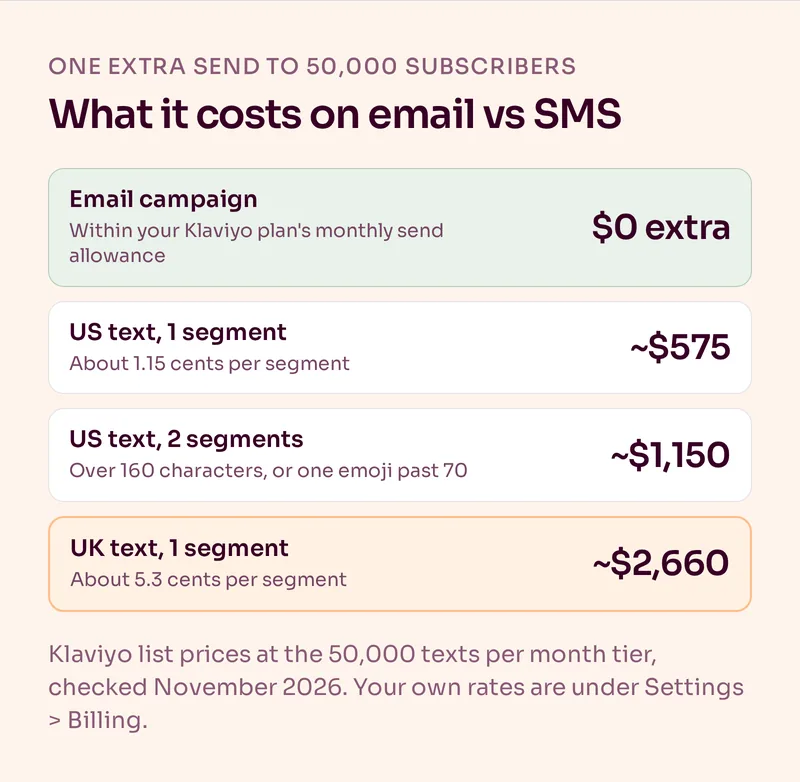
On a Klaviyo plan that works out to about 1.15 cents per segment, one 1-segment text to 50,000 US subscribers costs about $575. Make it 2 segments and you're at about $1,150 for the same message. We break the rates down in how much SMS marketing costs.
Is SMS Better Than Email for Ecommerce?
Not in general. A text can bring in a lot of revenue per send, but SMS revenue isn't the KPI. Profitable revenue is.
Here's the math we walk every client through. A text campaign shows $800 in revenue and cost $500 to send. At a 60% contribution margin, that $800 is $480 of contribution. The campaign lost $20, and that's assuming the text caused every one of those orders.
So on every SMS review, we put the messaging cost right next to the revenue. Green if the revenue is many times the cost. Orange if the cost is starting to look significant, and we dig in. Red if the cost is close to the revenue, and we change the plan or move the message back to email.
Email doesn't need that check on every send, because the extra cost is close to zero. That's the whole difference in one sentence.
When Should You Use SMS Instead of Email?
Use SMS when the message is urgent, short and going to people who are likely to act right away. These are the campaigns we think are worth a text:
- Sale launch
- Sale ends tomorrow
- Sale ends tonight
- Product launch
- Restock
Extra sale reminders on top of those only make sense around Black Friday and Cyber Monday.
For automations, SMS earns its place in the welcome flow, the abandoned cart flow and the abandoned checkout flow, and sometimes in browse or site abandonment.
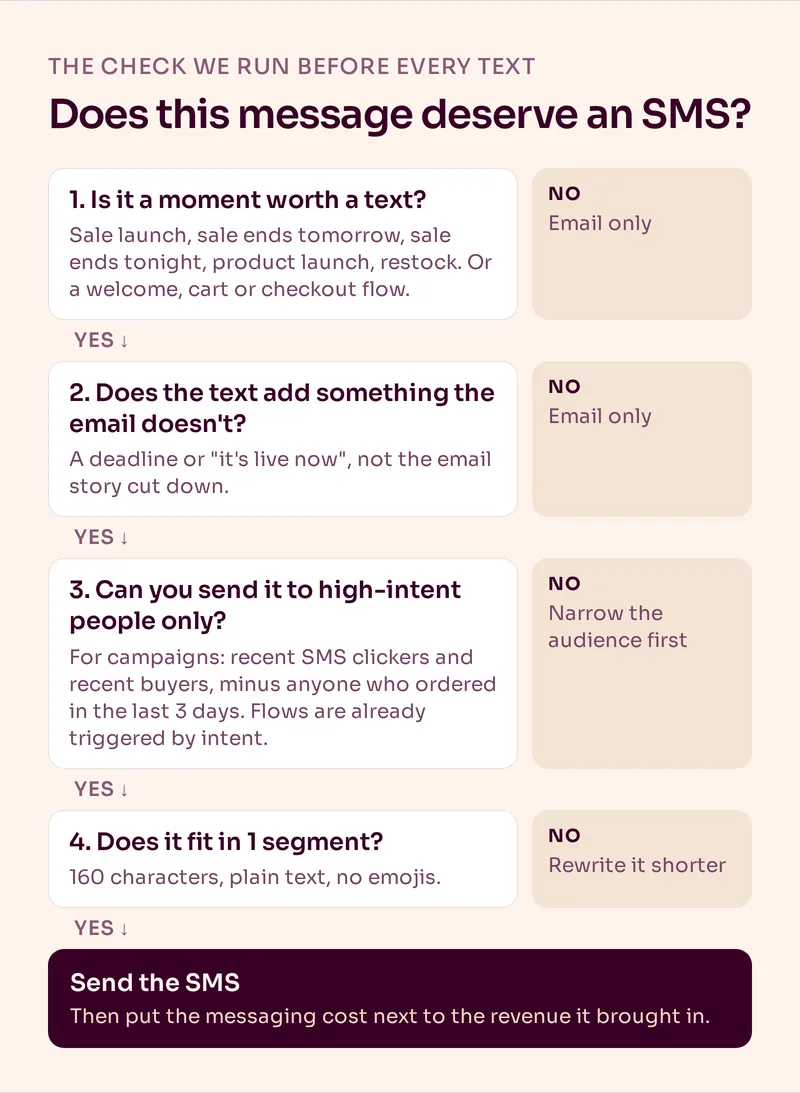
Even inside that list, ask one more question: does the text add something the email doesn't? A sale ending tonight, yes. A product story with six photos, no.
When Should You Stick With Email?
Use email whenever the message needs room or isn't urgent. That's most of what an ecommerce brand sends:
- product education and how-to content
- new collections that need visuals
- brand stories and founder notes
- reviews and social proof
- anything the reader doesn't need to act on today
An unnecessary email is easy to ignore. An unnecessary text on someone's phone gets annoying much faster, and you paid for it. If email can do the job just as well, don't pay for the SMS.
How Should SMS and Email Work Together?
Let email carry the detail and let SMS carry the moment. Don't send the same message twice.
A typical sale looks like this for us:
- Email announces the sale and explains the offer to the engaged segment.
- SMS tells recent SMS clickers and recent customers that it's live, in one short segment, with a link that applies the discount code automatically.
- Email does the work in between: bestsellers, reviews, bundles.
- SMS sends "ends tomorrow" and "ends tonight" to the same high-intent group.
Every SMS campaign also leaves out anyone who ordered in the last 3 days. Nobody wants a "sale ends tonight" text the day after they bought. More on sequencing the two channels in our ecommerce SMS marketing strategy.
Who Should Get Your SMS Campaigns?
Not your full SMS list. Start with people who clicked a text recently and people who bought recently, and leave out customers who ordered in the last 3 days. Broaden only when a campaign really deserves it, like a Black Friday launch.
It's the same thinking as sending email to an engaged segment, with a stricter bar, because every extra recipient costs money.
Everyone on that list needs separate, explicit SMS consent first. We cover how to collect it in our guide to SMS opt-in.
Does It Change for UK and European Brands?
Yes. A UK text costs about 5 times what a US text costs on Klaviyo's list prices, so we're much stricter there: smaller audiences, fewer sends, and an honest look at whether it needs to be a text at all. For brands selling across Europe, WhatsApp is often worth comparing with SMS before you commit to either.
So Should You Use SMS or Email?
Use both, but not equally. Email is your default for almost everything. SMS is a small, deliberate layer for the few moments where speed matters and the audience is ready to buy. Keep every text to 1 segment, send it to the people most likely to act, and judge it on profit instead of the revenue number in Klaviyo. If you want help getting that balance right, that's what our SMS marketing service is for.
Frequently Asked Questions
What's the difference between SMS and email marketing?
Email is priced by plan, has room for images and detail, and costs almost nothing per extra send. SMS is billed per message segment, fits 160 characters per segment and needs separate consent. Email does most of the work, and SMS is for short, urgent moments.
Is SMS marketing more effective than email?
A text can bring in more revenue per recipient on the right send, but it also costs far more per send. Judge SMS on profit after messaging costs, not on revenue alone. For most messages, email is the better choice.
How much more does SMS cost than email?
On Klaviyo's list prices, a US text costs about 1 to 1.5 cents per segment per recipient, and a UK text about 5 to 7 cents. An extra email usually costs nothing extra within your plan's monthly send allowance.
Should I send every email campaign as an SMS too?
No. Only send a text when it adds something the email doesn't, like a launch going live or a sale ending tonight. Copying every email into an SMS doubles the noise and adds cost.
Which ecommerce flows should include SMS?
The welcome flow, the abandoned cart flow and the abandoned checkout flow, and sometimes browse or site abandonment. Those are high-intent moments where a short text can help.
How many SMS campaigns should an ecommerce brand send?
Far fewer than email. We text for sale launches, sale ends tomorrow, sale ends tonight, product launches and restocks, plus extra sale reminders around Black Friday and Cyber Monday.
Want Us to Build and Manage This for You?
Related Reading
SMS & WhatsApp
How Much Does SMS Marketing Cost? What Ecommerce Brands Actually PayWhat SMS marketing actually costs on Klaviyo in 2026, per text and per month, where the hidden costs sit, and how we decide whether a send was worth it.
Read NowSMS & WhatsApp
SMS Marketing Strategy for Ecommerce: When to Send and What to AutomateSMS works best when the customer moment is important enough to justify the interruption. Here is how we decide where text messaging belongs in an ecommerce retention system.
Read NowSMS & WhatsApp
SMS Marketing Best Practices for Ecommerce: How We Actually Use SMSSMS is not email with fewer characters. Here's how we use it for ecommerce without burning the list, training customers to ignore texts or destroying opt-in value.
Read NowSMS & WhatsApp
Klaviyo SMS Marketing: How to Set It Up and What's Worth SendingAlready on Klaviyo and not sure SMS is worth it? How to set it up, what a send really costs, and the campaigns and flows we'd text first.
Read Now