
Industries · Supplements
Email marketing for supplement brands
A customer buys a 30-serving tub on the 3rd. By the 28th it is nearly empty, and whatever lands in their inbox that week decides whether they reorder from you or grab something at the store.
Supplement email lives and dies on that moment. We build Klaviyo email and SMS programs for supplement and sports nutrition brands that get the timing right, keep claims on the safe side of the line, and turn one bottle into a habit.

Why supplement email needs its own playbook

a recipe content email
Most ecommerce categories sell a product. Supplements sell a routine. The first order is a trial, and the real business starts with order two and three.
That changes what email has to do:
- Results take weeks. A customer who has not felt anything by day 10 is a churn risk, so the post-purchase flow has to manage expectations and keep them taking it.
- Every SKU has a clock. Serving size and pack size tell you almost exactly when someone runs out. Generic "it's been 30 days" reminders leave money on the table.
- Claims are regulated. What you can say about a product in the US is limited by the FDA and FTC. A subject line that promises a health outcome can create real risk.
Related case study
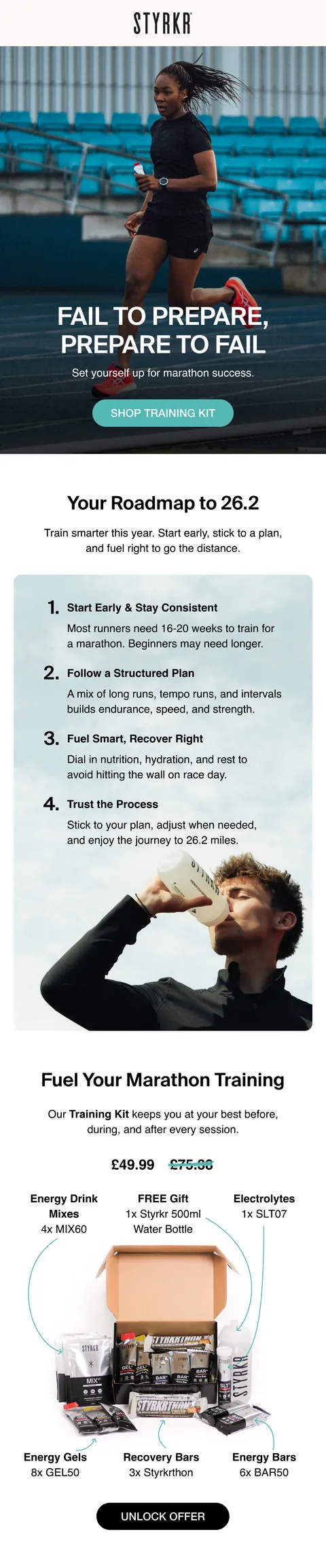
Read the STYRKR case studya recipe content email
Where supplement LTV is actually decided
Timing and claims are the basics. These are the levers we look at next, because they decide how much a supplement customer is worth over a year.
- Benchmark against your own category. Consumables should see roughly 30 to 45 percent of customers place a second order. A supplement brand at 23 percent has a gap in its system, even though the same number would be healthy for an apparel brand. Sizing that gap is the first thing we do.
- Sell servings and routines. Offers, bundles and subscription plans are framed as days of use, so a bigger plan reads as a longer habit instead of a bigger tub. Bundles are named after the goal they support, and the first order is sized to how fast the product is really used.
- Climb a ladder in the late welcome emails. Someone who ignored the first code rarely needs a deeper discount. The later emails offer a different way in: a subscription for people who do not want to commit to one bottle, a bundle for people unsure what goes together, then a reason to join your rewards program.
- Name the fail point before it arrives. Week four is where people who have not noticed anything yet cancel. Onboarding sets an honest 30, 60 and 90 day picture, written within your claims, so a slow start does not turn into a refund.
- Win back at the real window. For most supplements the second order lands around day 25 to 30. A winback that waits for day 90 reaches people two months after they switched brands.
Replenishment built from the label
We calculate a run-out date per product and per quantity. A 60-capsule bottle taken twice a day runs out around day 30. Two bottles bought together run out around day 60. A tub of protein used once a day lasts as long as its serving count.
The reminder goes out roughly five to seven days before that date, so the next order arrives before the last scoop. A second nudge follows on the run-out date with a one-click reorder link. If they reorder through a subscription, the flow stops for them.
When customers keep buying earlier or later than the label suggests, we adjust the timing to the real gap between orders in your data.
Keeping them on it past week three
The weakest point for most supplement brands is the gap between delivery and the first noticeable result. Our post-purchase flow for supplements covers:
- How and when to take it, with the simplest possible routine.
- What a realistic timeline looks like, phrased as customer experience and backed by your evidence.
- A check-in around week two or three that asks how it is going and routes unhappy answers to support before they turn into a refund request.
- A review request timed after the customer has had a fair chance to notice a difference, usually not before day 21.
Claims, compliance and SMS
We write supplement copy with structure and function language and avoid disease claims. Statements like "supports recovery" are treated differently from "treats inflammation", and testimonials can create claims too, so we screen them the same way. Where your labels carry the FDA disclaimer, we carry it into emails that make structure or function statements. Final legal sign-off stays with your team.
SMS works well for supplements: reorder reminders, restocks and subscription updates are short, useful messages. We keep promotional texts to a few a month and link them to pages that are clean of any wording carriers might flag.
The flows we build first for supplement brands
- Welcome series
- Product-specific post-purchase
- Replenishment flow
- Subscription onboarding and cancellation
- Cross-sell
Welcome series that explains which product fits which goal before pushing a discount. See how we approach the welcome email series at welcome email series.
Read more →Product-specific post-purchase with usage, timeline and a check-in. More on this at post-purchase email sequence.
Read more →Replenishment flow per SKU and quantity, explained in depth at replenishment emails.
Read more →Subscription onboarding and cancellation flows for Recharge, Loop or Skio. See subscription onboarding and subscription marketing.
Read more →Cross-sell from a first product into a stack that makes sense, for example a pre-workout buyer into recovery. See Klaviyo cross-sell flow.
Read more →Winback that checks whether someone simply ran out or actually stopped. See Klaviyo winback flow.
Read more →
- Welcome series
- Product-specific post-purchase
- Replenishment flow
- Subscription onboarding and cancellation
- Cross-sell
FAQ
How often should a supplement brand email its list?
Most established supplement brands we work with send three to four campaigns a week to engaged subscribers, alongside always-on flows. Education and social proof should carry most of those sends, with promotions kept for a few moments a month so people keep paying full price.
When should a replenishment email go out for a 30-day supplement?
Start with about five to seven days before the calculated run-out date, so the reorder arrives before the product is gone. Then adjust it to the real time between orders in your own data, by product and by quantity purchased.
Can supplement brands use SMS marketing?
Yes. Supplements are generally allowed on SMS in the US. Keep health claims out of texts and off the pages you link to, collect proper consent, and use SMS for reorder reminders, restocks and a small number of promotions.
What can I say about my supplement in marketing emails?
In the US you can usually make structure and function claims such as "supports joint comfort" if you can back them with solid evidence, and you need to avoid claims that a product treats, cures or prevents a disease. Testimonials count as claims too. Your own regulatory advisor should sign off on final wording.
What is a good repeat purchase rate for a supplement brand?
For consumables such as supplements, we expect roughly 30 to 45 percent of customers to place a second order. Below that range, there is usually a gap in the post-purchase, replenishment or subscription setup. Compare your number with your own category, because the ecommerce average of around 17 to 25 percent includes categories that are rarely repurchased.
Related Reading
Email Automations
Replenishment Emails: How to Time Them Around Real Customer BehaviorThe best replenishment email does not feel like a promotion. It arrives when the customer is actually running low. Here's how we build the timing around real purchase behavior.
Read NowRetention Strategy
Consumable Products: Why Boring Products Build the Most Profitable Ecommerce BrandsSoap, cereal, hand sanitizer. Nobody gets excited about them, and that's the point. Why products that run out build stronger ecommerce brands, and how to time the reorder.
Read NowRetention Strategy
Subscription Retention: How Ecommerce Brands Keep Customers LongerSubscription retention starts long before cancellation. Improve product use, first renewals, billing reminders, flexibility and subscriber communication before relying on winback.
Read NowAnalytics & Testing
Average Time Between Orders: How to Calculate It and Use It to Time Your EmailsDay 14 and day 90 are template numbers. Here's how to find your real time between orders and use it to time your cross-sell, replenishment and winback emails.
Read Now