
Deliverability
Email Warm Up: How to Warm a New Sending Domain or IP in Klaviyo
Quick answer: Email warm up is how you build a sending reputation: you start with small sends to your most engaged subscribers and increase volume step by step. You need it when you move to Klaviyo from another platform, start sending from a new or unused domain, get a dedicated IP or come back after a long pause. Klaviyo recommends at least 30 days of warming with good performance. Start with people who clicked in the last 30 days, and widen the audience only while opens, clicks, bounces and spam complaints stay healthy.
Inbox providers don't trust strangers.
A brand new domain that suddenly emails 100,000 people looks like a spammer. So does a brand that normally emails 10,000 people and jumps to 200,000 overnight. Or one that goes quiet for three weeks and then sends every day.
Warming is how you avoid looking like any of those. You start small, with people you know want your email, and let Gmail, Yahoo and Outlook see real people opening and clicking before you send to everyone else.
One note before we start. If you searched for "email warm up" and found tools that send emails between inboxes to warm up a cold outreach address, that's a different use case. This page is about marketing email from your brand to people who subscribed.
By Emiel Dingemans, Founder of Magicianly
Updated
What Is Email Warm Up?
Email warm up means sending small volumes to your most engaged subscribers first, then increasing volume and widening the audience in steps, so inbox providers learn that people want your email. It applies to a new sending domain, a new IP address and a move to a new email platform.
Klaviyo uses two terms here:
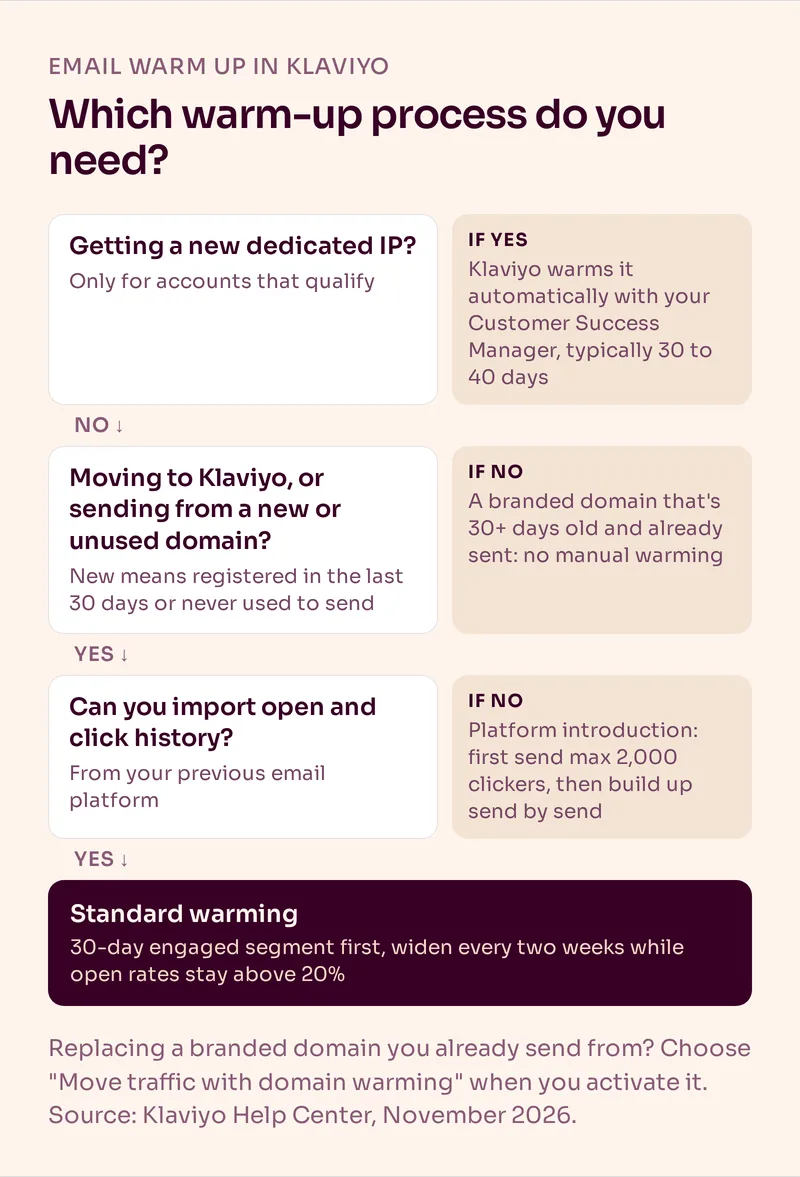
- Warming builds a reputation for new or "cold" infrastructure: a domain registered in the last 30 days or never used to send email, or an IP that hasn't sent email in the last 30 days.
- Ramping is the gradual increase in volume that's part of warming. You also ramp when you move to Klaviyo's shared IPs, and when you plan to send a lot more ahead of a busy period like Black Friday.
Most people say "warm up" for both, and so do we. Gmail's sender guidelines put the same idea plainly: increase sending volume slowly, and the more email you send, the more slowly you should increase it.
When Do You Need to Warm Up Your Email?
You need to warm up when inbox providers have no recent history for the domain or IP you send from, or when your volume is about to change a lot. These are the situations we see most:
| Situation | Warm up? | What Klaviyo recommends |
|---|---|---|
| Moving to Klaviyo from another platform | Yes | Standard warming if you can import open and click history, platform introduction if you can't |
| New sending domain (registered in the last 30 days or never used) | Yes | Warm it, also if you're already a Klaviyo customer |
| Moving to a branded sending domain you've already sent from | Usually not | No manual warming if the domain is at least 30 days old and has sent email before |
| Replacing your current branded sending domain | Let Klaviyo do it | Choose "Move traffic with domain warming" when you activate the new domain |
| New dedicated IP | Yes | Klaviyo warms it automatically with your Customer Success Manager, typically in 30 to 40 days |
| Stopped sending campaigns for a while | Yes | Rewarm the domain if you stopped sending campaigns entirely |
| Much higher volume planned for Black Friday | Ramp up | Increase volume gradually in the lead-up |
Source: Klaviyo Help Center, which warming process to use, checked November 2026.
Transactional and service domains usually don't need warming. Klaviyo's reasoning is that order confirmations and password resets are lower-volume emails that customers trigger themselves.
How Long Does Email Warm Up Take?
Plan for at least 30 days. Klaviyo says warming should take a minimum of 30 days with good performance, and that mailbox providers typically take up to 30 days to make an initial decision about your reputation. Opens and clicks can keep moving around for up to about 120 days while that reputation settles.
So don't read too much into one odd week in month two. Do act fast if bounces or spam complaints climb.
What Does a Warm-Up Schedule Look Like?
A warm-up schedule starts with a few thousand of your most engaged profiles and roughly doubles from send to send while results hold. If you can't bring engagement history into Klaviyo, its platform introduction process gives exact volumes. For a brand sending three campaigns a week, it looks like this:
| Week | Max recipients per email (3 sends a week) | Who to send to |
|---|---|---|
| 1 | 2,000, then 4,000, then 8,000 | Clicked in the last 30 days |
| 2 | 14,000, then 21,000, then full volume | Clicked or opened in the last 30 days |
| 3 and 4 | Full volume | Clicked or opened in the last 30 days |
| 5 | Full volume | Clicked or opened in the last 60 days |
| 6 | Process complete | Keep using engaged segments |
"Full volume" doesn't mean your whole list. Klaviyo says to keep using the suggested engagement segments even then.
If you do have open and click history, Klaviyo's standard warming process works with time windows instead. Send to a 30-day engaged segment for the first two weeks, move to 60 days in weeks 3 and 4 if open rates stay above 20%, then to 90 days, and later to 120 and 180 days. Klaviyo recommends fewer than 10,000 recipients for the first campaign.
Before every step up, look at open rate, click rate, bounces, unsubscribes and spam complaints. If they get worse, stay where you are.
How Do We Warm Up a Klaviyo Account?
We run a stricter version of the same idea. It's the ladder we use when an account's inbox placement has slipped, as part of the recovery process in our Klaviyo deliverability guide, and it works just as well for a fresh start.
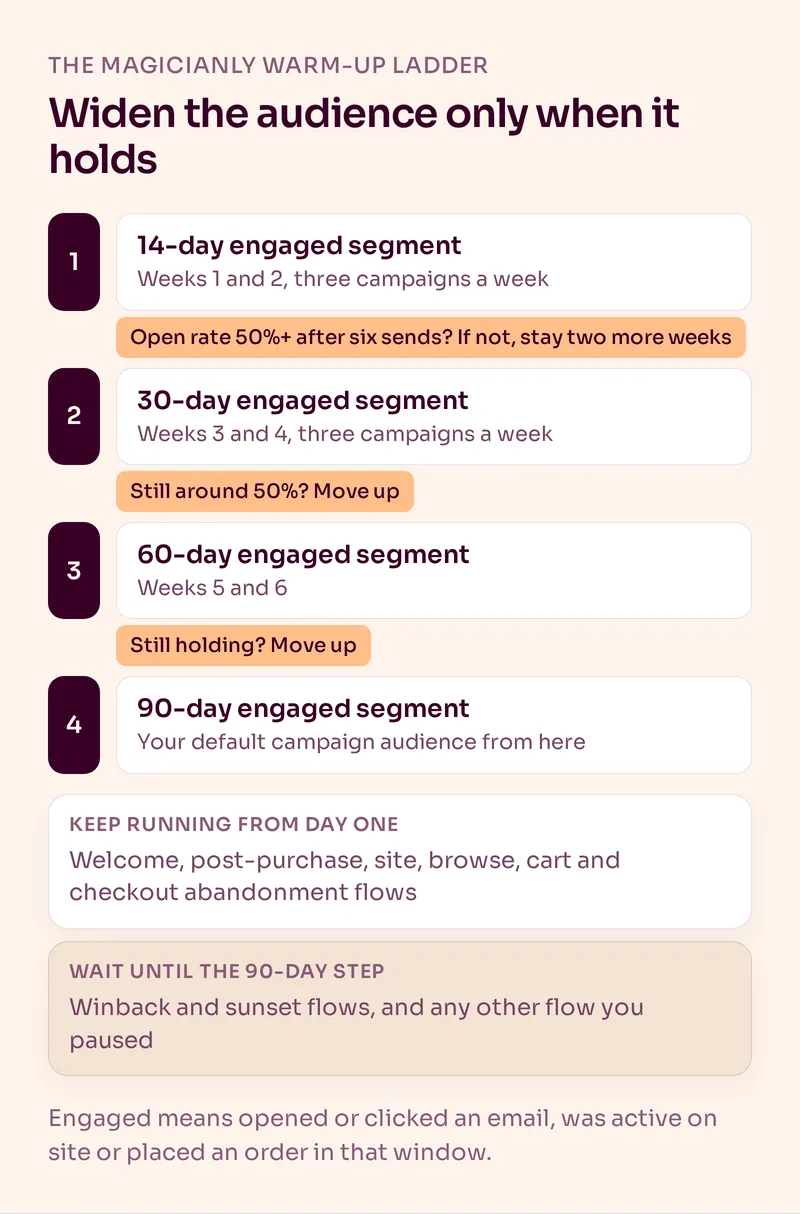
Weeks 1 and 2: three campaigns a week to your 14-day engaged segment only
Check: after those six sends, is the open rate 50% or higher? If not, stay two more weeks
Weeks 3 and 4: three campaigns a week to your 30-day engaged segment
Weeks 5 and 6: your 60-day engaged segment, if open rates held
After that: your 90-day engaged segment becomes the default campaign audience
The rules that go with it:
- Engaged means more than opens. Our engaged segments include anyone who opened or clicked an email, was active on the site or placed an order in that window. If you're fixing a serious spam problem, start with email engagement only.
- Keep the high-intent flows, pause the rest. During the first weeks we keep the welcome, post-purchase and abandonment flows running (site, browse, cart and checkout) and pause everything else. Winback and sunset flows wait until the ladder reaches the 90-day segment. Klaviyo also treats winback, re-engagement and sunset flows as high risk until warming is complete.
- Steady beats big. If you can't keep up three campaigns a week, two a week on a steady rhythm is better than bursts.
- Suppress before you start. Hard bounces, spam complainers and people who never engaged come out first. Klaviyo calls suppressing never-engaged profiles the best first step, and our email list cleaning guide shows who else to remove.
Once the 90-day segment holds, you can keep widening to 120, 150 or 180 days, as long as open rates stay strong. We explain how this connects to open rates in how to increase email open rates.
Do You Need SPF, DKIM and DMARC Before You Warm Up?
Yes. Set up your branded sending domain and a DMARC record before the first warm-up send. Otherwise you build a reputation on a setup you'll have to change later, and the change can mean warming again. Our guide to SPF, DKIM and DMARC shows the records and how to add them in Klaviyo.
What Are the Most Common Email Warm-Up Mistakes?
The mistakes we see most often:
- Sending to the whole imported list on day one. That's exactly the pattern inbox providers are trained to distrust.
- Jumping too fast. Going from 5,000 to 50,000 because the first send went well.
- Pausing halfway. If you need to slow down, Klaviyo recommends a stricter, smaller segment instead of stopping.
- Turning on winback and sunset flows too early. The most common way we see a warmed account go cold again is a reactivation, winback or sunset flow pointed at an old, stale part of the list. Bounces spike and every send pays for it.
- Judging on opens alone. Apple Mail Privacy Protection inflates open rates, so watch clicks too. Klaviyo itself tells dedicated IP senders to use clicks as the main engagement signal.
- Skipping the ramp before Black Friday. If you've sent twice a week all year, don't jump to daily sends to everyone in November. Build up in September and October, which we cover in our Black Friday email marketing guide.
So How Should You Warm Up Your Email?
Get your branded sending domain and DMARC in place, suppress bounces, complainers and never-engaged profiles, then start small with your most engaged subscribers. Follow Klaviyo's schedule for a new domain or a platform move, or our 14, 30, 60 and 90-day ladder when placement has slipped. Step up only when opens, clicks, bounces and complaints hold, keep a steady rhythm and leave winback and sunset flows off until you're at the 90-day segment. Plan for 30 days at least. If you'd rather have us run the warm-up and the sending after it, that's part of our Klaviyo management work.
Frequently Asked Questions
What does it mean to warm up an email domain?
Warming up means building a sending reputation for a domain step by step. You start with small sends to your most engaged subscribers and increase volume and audience only while opens, clicks, bounces and spam complaints stay healthy.
How long does it take to warm up a new domain in Klaviyo?
Klaviyo recommends at least 30 days of warming with good performance. Mailbox providers typically take up to 30 days to make an initial decision about your reputation, and engagement can keep fluctuating for up to about 120 days.
Do I need to warm up if I switch from Mailchimp to Klaviyo?
Yes. Any move to a new email platform needs warming or ramping. Import your open and click history if you can, so you can build engaged segments, and use Klaviyo's platform introduction process if you can't.
What is the difference between IP warming and domain warming?
Domain warming builds a reputation for your sending domain, which you need whenever that domain is new or unused. IP warming only applies if you have a dedicated IP. In Klaviyo, dedicated IP warming runs automatically with your Customer Success Manager and typically takes 30 to 40 days.
Can I pause sending during an email warm up?
Try not to. Inbox providers judge consistency. Klaviyo recommends sending to a smaller, stricter segment instead of stopping, and says you need to rewarm the domain if you stop sending campaigns entirely.
Do transactional emails need warming?
Usually not. Klaviyo says transactional and service domains typically don't need warming, because they carry lower-volume emails that customers trigger themselves, such as order confirmations and password resets.
Want Us to Build and Manage This for You?
Related Reading
Deliverability
How to Fix Email Deliverability Problems in KlaviyoA practical ecommerce deliverability framework covering technical setup, list hygiene, engagement and controlled audience expansion.
Read NowDeliverability
SPF, DKIM and DMARC: What They Do and How to Set Them Up for Ecommerce EmailDMARC is the record most ecommerce brands are missing. Here's what SPF, DKIM and DMARC each do, a record you can copy and the policy to start with.
Read NowDeliverability
Email List Cleaning: When to Suppress Inactive SubscribersA bigger email list is not automatically a better email list. Here is how we separate inactive subscribers from valuable past customers and when suppression actually makes sense.
Read NowEmail Campaigns
How to Increase Email Open Rates (It's Usually Not Your Subject Lines)You've tested emojis, send times and subject line after subject line, and your open rates barely moved. Here's what actually fixes them, in the order we fix it.
Read Now