
Retention Strategy
Email Marketing Best Practices: 5 Lessons From Sending 700 Million Emails
Quick answer: These are the email marketing best practices we still follow after sending more than 700 million emails for ecommerce brands. Send campaigns to an engaged segment instead of your whole list. Review your core flows every six months. Keep it to one real sale a month. Send three to four emails a week that people actually want. And only trust A/B tests that change one thing and are decided on orders, with enough people in each group.
By Emiel Dingemans, Founder of Magicianly
Updated
You've heard the standard advice a hundred times. Grow your list as big as you can. Don't email too often or people will unsubscribe. Set up your flows once and let them run. Always be A/B testing.
It all sounds reasonable. But over the last seven years we've sent over 700 million emails for our clients, and a lot of that advice turned out to be wrong. Some of it is quietly costing brands money right now.
Each lesson below cost us, or a client, real money to figure out. Here's what we do instead.
| The advice you usually hear | What we do instead |
|---|---|
| Grow your list as big as possible | Send campaigns to people who engaged in the last 90 days |
| Set up your flows once and let them run | Review the core flows every six months |
| Send a discount when sales are slow | One real sale a month, other reasons to buy in between |
| Don't email too often | Three to four useful emails a week to the engaged list |
| Always be A/B testing | Test one big thing at a time and judge it on orders |
Is a Bigger Email List Always Better?
No. List size on its own is a vanity metric. We've seen brands with 100,000 subscribers make less from email than brands with 20,000.
A subscriber who never opens your emails is worth nothing to you. Actually, it's worse than nothing. Klaviyo bills by active profiles, so you pay for every profile you can email, and the people who keep ignoring you drag down your deliverability.
Gmail and Outlook watch how people react to your emails. When a big part of your list ignores you, they figure people don't want your mail and start putting it in Promotions or spam. And that doesn't only hit the people who ignore you. It hits everyone, including your best customers.
So here's what we do:
- Campaigns go to the engaged list. That's people who clicked an email, visited your site or placed an order in the last 90 days. If your deliverability isn't great, go tighter: 60 or even 30 days.
- Aim for open rates of 50% or higher on those engaged campaigns. Apple Mail inflates opens these days, so treat it as a quick health check, not as proof.
- Everyone else gets one or two emails a month. That still gives unengaged subscribers a chance to come back.
- If they still don't engage after a couple of months, stop emailing them. In Klaviyo, that means suppressing them.
I know how that sounds. You worked hard to get those people on your list. But a smaller list often makes more money, simply because your emails start reaching the inbox again. We go deeper on the why and the how in our guide to email engagement.
Can You Set Up Email Flows Once and Leave Them?
No. Flows are the most predictable revenue you've got, but they go stale like everything else. Your products change, your offers change, your brand changes, and the inbox changes too.
Here's what we keep finding when we audit a new account:
- A welcome flow that was built three years ago
- A discount code that expired months ago
- A product in email three that's been sold out since last summer
- Designs that look nothing like the brand does today
Nobody noticed, because the flow was still making some money. Just not nearly as much as it could.
The inbox moves too. Two years ago, a welcome flow with 7 to 12 emails was totally fine. Today a shorter, front-loaded welcome flow does better, because attention spans are shorter and there's more competition in the inbox. Our Klaviyo welcome flow guide shows how we build one now.
That's why we go through every client's core flows every six months. Flows reach people at the exact moment they're most interested, so small gains add up fast. A few extra percent on your abandoned cart flow keeps paying out every single day for as long as that flow runs.
- Links and codes: click every link and test every discount code that's still in the flow.
- Products: swap out anything that's sold out, discontinued or no longer worth featuring.
- Design: match how the brand looks today, not three years ago.
- Copy: refresh it, and cut emails that no longer earn their spot.
- Offers: test a new offer, including options that aren't a discount.
Do Discounts Hurt Your Email Marketing?
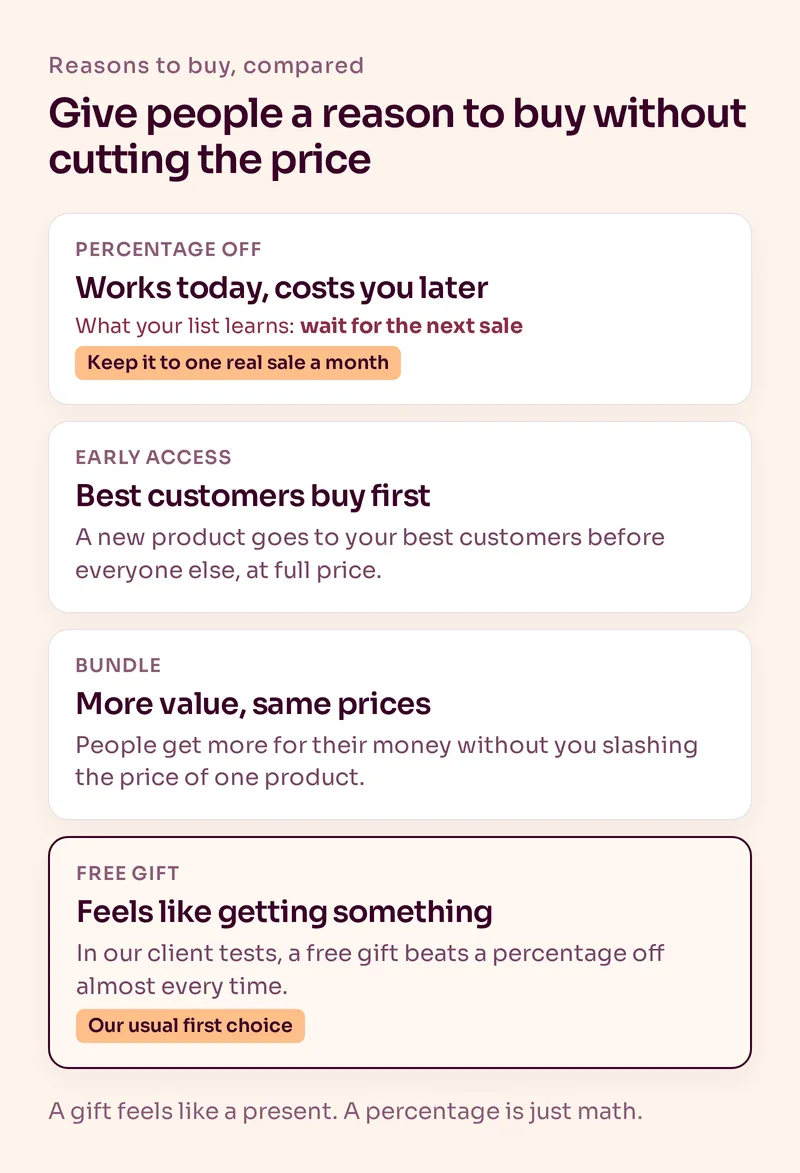
They can. Discounts work in the short term, and that's the trap. You send 20% off, sales come in the same day, and it feels like the right move.
But every discount blast teaches your list one thing: don't buy at full price, because a sale is coming. After a while, that's exactly what people do. They see your new product email, they like it, and they decide to wait for the next sale. Your customers aren't stupid. If you've sent them a discount every two weeks for the last year, they know the pattern better than you do.
Here's how we fix it:
- One real sales event a month, max. That's what we do for most of our clients. There's more on calendar rhythm in how often to send marketing emails.
- Give people a reason to buy without cutting the price. Early access, so your best customers get a new product before everyone else. A bundle, so people get more value without you slashing the price of one product. Or a free gift.
The free gift is the one we like most. AG1 is a good example: new subscribers get a free welcome kit with their first order, and that's the offer they lead with, not a percentage off. When we've tested it for our own clients, a free gift beats a percentage off almost every time. A gift feels like getting something. A percentage is just math.
How Many Marketing Emails Should You Send a Week?
Probably more than you do now. Most founders are so worried about unsubscribes that they send one email a week, sometimes less.
When we move clients from one email a week to three or four a week to their engaged list, revenue goes up and deliverability doesn't get worse. Often it gets better. Bigger brands, doing over $1 million a month, can often go to five or six a week, as long as list growth keeps up with the extra unsubscribes.
Why does it work? Your customers are busy. They don't read every email you send. Most of the time they see your name in the inbox while they're scrolling on their phone, and they keep going. Once a week just isn't enough to show up. Sending on a steady schedule helps too, because inbox providers like senders who are predictable.
And unsubscribes? Yes, you'll probably get a few more. But an unsubscribe doesn't hurt your deliverability. A spam complaint does. Gmail's one-click unsubscribe button has made leaving easier, and honestly, that's fine: someone who unsubscribes isn't hitting the spam button. The people who leave were rarely going to buy anyway, even at one email a week. Our email unsubscribe rate guide covers when a rate is actually worth worrying about.
There's one catch. This only works if most of your emails are worth opening. We're not saying send three discounts a week. Send three or four emails a week that people like getting.
- A customer story: a real customer and how they use the product.
- A product tip: how to get more out of something they already bought.
- Behind the scenes: how the product is made, or who makes it.
- A new launch: what's new and why it exists.
- The sale: one real sales event a month on top, not one a week.
Why Are Most Email A/B Tests Wrong?
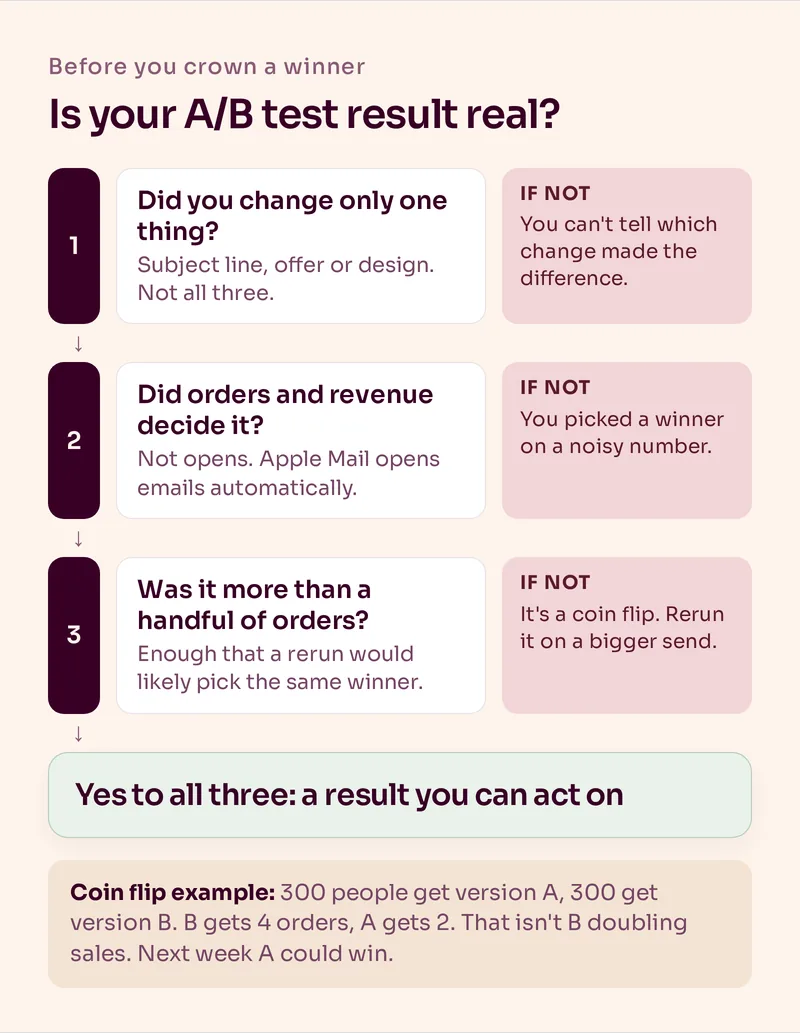
Because the samples are too small to mean anything. Most A/B tests we see are decided by a handful of orders, and that's luck, not a result.
Here's what usually happens. A brand tests a subject line. Version A goes to 300 people, version B goes to 300 people. B gets four orders and A gets two. "Great, B doubled our sales, we'll use that from now on." It didn't. That's a coin flip. Run the same test next week and there's a good chance A wins. We've seen brands make big decisions on tests like that, and we got this wrong ourselves early on.
How we test now:
- Change one thing at a time. If you change the subject line, the offer and the design all at once, you have no idea which one made the difference.
- Get enough people in each group, and judge on orders and revenue. Not open rate. Opens aren't that reliable anymore, especially since Apple Mail opens emails automatically. If a handful of orders decides the winner, it isn't a winner.
- Test the things that matter first. Your offer, your angle, whether a plain-text email beats a designed one. Those can move your results a lot. Button colors and a slightly different subject line usually won't.
Our full process, from hypothesis to documenting what you learned, is in email A/B testing for ecommerce.
Which Best Practice Should You Start With?
Start with who you send to. If a big part of your list keeps ignoring you, nothing else lands, because your emails aren't reaching the inbox. Then fix frequency and content. Then refresh your flows. Then build a testing habit around the big questions.
If you want the full order of operations, including your signup forms, our guide on how to improve email marketing performance lays it out step by step.
So What Are the Email Marketing Best Practices That Actually Work?
A smaller engaged list beats a big one that ignores you. Flows need a checkup twice a year. Discounts need a ceiling. Most brands should send more, not less, as long as the emails are worth opening. And a test decided by two orders isn't a test.
None of this is fancy. It's just what held up after 700 million emails.
Frequently Asked Questions
What are the most important email marketing best practices?
Send campaigns to an engaged segment instead of your full list, keep your core flows up to date, cap real sales at about one a month, send often enough to stay visible, and judge tests on orders instead of opens. Those habits matter more than any template or subject line trick.
How often should an ecommerce brand send marketing emails?
For most established brands, three to four emails a week to the engaged list is a good place to be. Bigger brands can often send five or six if their list growth keeps up. One email a week is usually too little to stay visible.
Will sending more emails increase unsubscribes?
Usually a little, yes, and that's fine. An unsubscribe doesn't hurt your deliverability the way a spam complaint does, and the people who leave were rarely going to buy anyway.
How often should you update your email flows?
We review core flows every six months. Check every link, product and discount code, refresh the copy and design, and test a new offer.
How many people do you need for an email A/B test?
There's no single magic number, but if a handful of orders decides the winner, it isn't a real result. Run tests on your biggest sends and flows, change one thing at a time, and judge on orders and revenue. A 300 versus 300 split where one side gets four orders and the other gets two is a coin flip.
Is a free gift better than a discount?
In our client tests, a free gift beats a percentage off almost every time. It gives people a reason to buy without teaching them to wait for the next sale.
Want Us to Build and Manage This for You?
Related Reading
Deliverability
Email Engagement: Why a Smaller Engaged List Makes More MoneyA big list looks good. An engaged list pays. What email engagement is, which signals to trust now that opens are inflated, and who should get your campaigns.
Read NowEmail Campaigns
How Often Should Ecommerce Brands Send Marketing Emails?Sending less is not automatically respectful, and sending more is not automatically better. Here is how we think about email campaign frequency for ecommerce.
Read NowRetention Strategy
10 Email Marketing Mistakes Ecommerce Brands Keep MakingMost underperforming email accounts are not missing one secret tactic. They are making a few expensive mistakes repeatedly. Here are ten we see most often.
Read NowAnalytics & Testing
Email A/B Testing for Ecommerce: What to Test and How to Learn FasterA/B testing is useful only when the result changes a future decision. Here is how we prioritize high-impact tests across campaigns, flows, offers, timing and signup forms.
Read Now