
Retention Strategy
What Is Zero-Party Data, and How Should Ecommerce Brands Use It?
Quick answer: Zero-party data is information a customer gives you on purpose, like a product interest, a clothing size, a preferred email frequency, or why they bought. Forrester defines it as data that a customer intentionally and proactively shares with a brand. For ecommerce brands, it usually comes from a signup quiz, a short survey, or an email preference center. It only pays off if you store the answer on the profile and actually change what you send.
We already collect a lot of behavior in Klaviyo: viewed products, checkouts, orders. That is useful, and it is still a guess about why someone did it. Zero-party data is the customer telling you the preference directly.
By Emiel Dingemans, Founder of Magicianly
Updated
What Is Zero-Party Data?
Zero-party data is information a customer chooses to share with you, with a clear idea of why you are asking. Forrester's definition, still the one we use, is "data that a customer intentionally and proactively shares with a brand. It can include preference center data, purchase intentions, personal context, and how the individual wants the brand to recognize them."
Typical ecommerce examples:
- "I'm shopping for running shoes" on a signup popup
- "Email me weekly" on a preference page
- A post-purchase survey that asks why they bought, or how they heard about you
- A stated skin type, clothing size, or favorite collection
First-party data is what you observe yourself: a product view, a cart, a purchase, a click. Third-party data is information you buy or receive from someone else's audience file. You can use first-party behavior and zero-party answers together. The second one tells you the preference. The first one tells you whether they acted on it.
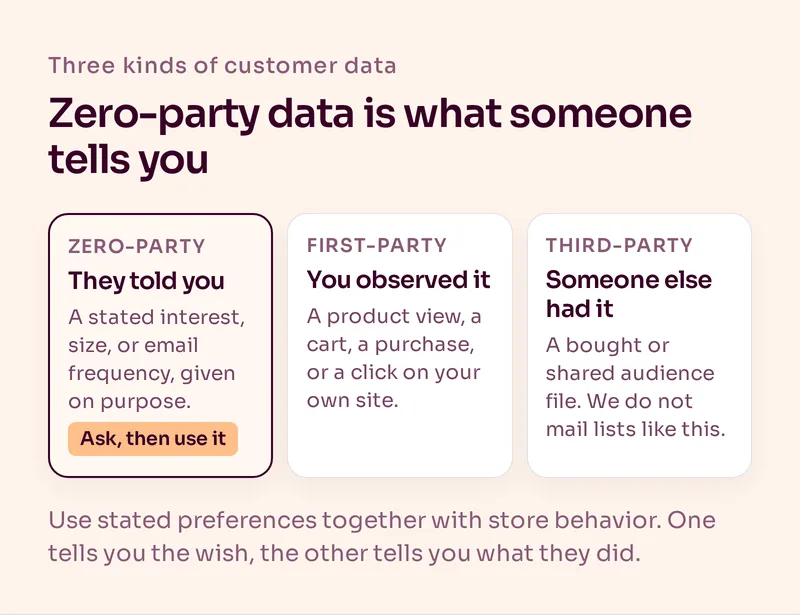
Zero-Party Data vs First-Party and Third-Party Data
| Zero-party data | First-party data | Third-party data | |
|---|---|---|---|
| What it is | What the customer told you | What you observed on your own site, emails or store | Information from another company's audience or data file |
| How you get it | Quizzes, surveys, preference pages, profile questions | Store events, email clicks, onsite behavior | Bought, shared or inferred from elsewhere |
| Example | "I prefer weekly emails" or "I'm shopping for gifts" | Viewed Product, Placed Order, clicked a campaign | A rented list or an off-site interest segment |
| Watch-out | Asking for data you never use | Inferring a preference the customer never stated | Weak consent, and weaker deliverability if you mail it |
We build retention programs on first-party store data plus a short list of zero-party answers. We do not buy lists.
How Do Ecommerce Brands Collect Zero-Party Data?
Ask in a place where the answer is easy to give and easy to use. Three places do most of the work for the brands we work with.
A signup popup or quiz. One question before the email field, or a short multi-step form, gives you a preference at the moment someone joins. That can be a product category, a gender, a use case, or the reason they are shopping. We wrote about the signup mechanics in how to build your Shopify email list, and about quizzes in Shopify popups with Alia and what a good popup signup rate looks like. If you want help building that capture, see our sign-up forms work.
A survey email or a thank-you page survey. After a first order, a short survey can ask why they bought or how they heard about you. Those answers are zero-party data too. See how we send survey emails and how to ask "how did you hear about us".
An email preference center. This is the page existing subscribers use to update frequency, content interests or channels. It is also zero-party data, and it is the one people can change later. We walk through the Klaviyo setup in how to build an email preference center.
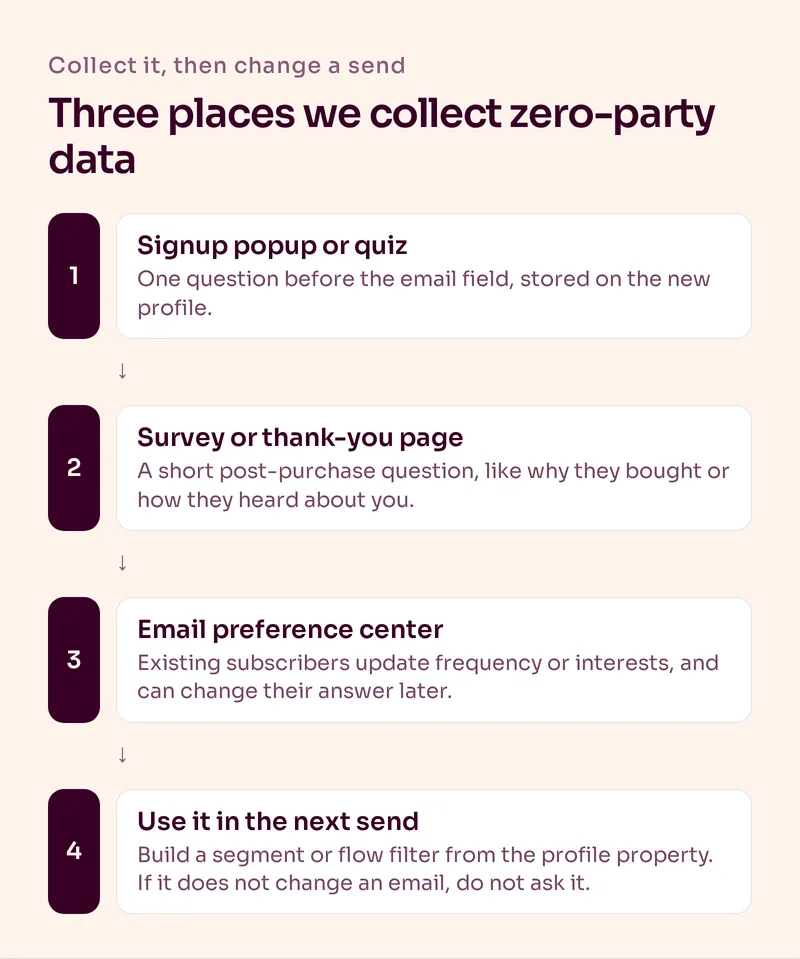
Keep the questions short. A popup that asks five things before the inbox offer will lose people. A preference page can hold more, because the subscriber already opted in and is there to manage the relationship.
How Do You Use Zero-Party Data in Klaviyo?
Collecting the answer is the easy part. The work is storing it on the profile and making it change a send.
In Klaviyo, popup, survey and preference-page answers should land as profile properties (or as events you can still segment on). Then you build segments and flow filters from those properties: people who said they shop menswear, people who asked for a weekly cadence, people who bought a gift. Welcome, campaign and replenishment content should follow the answer, instead of sending the same default to everyone.
We use it in three practical ways:
- Welcome and early campaigns. If someone told you they care about running, the second or third welcome email should help them shop running, not the whole catalogue.
- Frequency. If they asked for weekly emails, do not keep them on a four-sends-a-week campaign pace. That preference only works if you build the segments and actually schedule to them. Klaviyo does not automatically throttle a profile because a property exists.
- Ongoing personalization. Stated size, restock interest or content type can sit alongside purchase history. Our wider approach is in email personalization beyond first name.
If a question does not change a segment, a flow filter or a campaign, do not ask it.
Birthday, gender or "favorite color" only belong on the page if you have a send that uses them.
What Are the Most Common Zero-Party Data Mistakes?
Asking for more than you will use. Profile properties that never appear in a segment are just form friction.
Treating a stated preference as a permanent truth. People change. Let them update the same questions later in the preference center, and keep watching behavior. If someone said they love jackets and then spends six months buying shoes, believe the orders too.
Hiding the value exchange. Tell people why you are asking. "Tell us what you shop for, and we'll email you those products" is a fair deal. A long form with no explanation feels like an interrogation.
Leaving store data unused. Zero-party data works alongside Viewed Product and Placed Order. It fills in the preference those events cannot see.
So How Should You Use Zero-Party Data?
Start with one or two questions you can act on this month. Put them on the signup path, in a short survey, or on the preference page. Store the answers on the profile. Build the segment. Change the email. Then add more questions only when the last ones already change what people receive.
Frequently Asked Questions
What is zero-party data?
Zero-party data is information a customer intentionally shares with a brand, such as a product interest, a preferred email frequency or a reason for buying. Forrester popularized this definition. It is different from first-party data, which is behavior you observe yourself.
How is zero-party data different from first-party data?
Zero-party data is what someone tells you. First-party data is what you observe on your own website, emails or store, like a product view or a purchase. You usually need both: the preference and the behavior.
How do ecommerce brands collect zero-party data?
The usual places are a signup popup or quiz, a short survey email or thank-you page survey, and an email preference center. The right place depends on whether you are asking a new subscriber, a new buyer or an existing subscriber who wants to update what they get.
Does zero-party data replace purchase history in Klaviyo?
No. Keep using store events such as Viewed Product and Placed Order. Use zero-party answers for preferences those events cannot show, and let both signals work together.
What zero-party data should I collect first?
Start with something you will use in the next send: a product category, a use case, or how often someone wants email. Skip questions that only sit on the profile.
Is it okay to ask these questions on a popup?
Yes, if you keep it to one or two questions and the offer is still clear. A long quiz in front of the email field will usually cost you signups. Save longer preference questions for the preference page, once someone is already on the list.
Want Us to Build and Manage This for You?
Related Reading
Retention Strategy
Email Preference Center: How Ecommerce Brands Let Subscribers Choose What They GetAn email preference center is a page where subscribers update how often they hear from you, which topics they want, and whether they still want marketing email at all.
Read NowRetention Strategy
Email Personalization for Ecommerce: What to Personalize Beyond First NameReal email personalization is not inserting a first name. It is changing what someone receives based on what they viewed, bought, told you or are likely to need next.
Read NowEmail Automations
Survey Email: How Ecommerce Brands Get Answers They Can Actually UseOne question, the right moment, one click. Which surveys an ecommerce brand should send when, how to build a one-click survey in Klaviyo and what to do with the answers.
Read NowList Growth
What Is a Good Popup Signup Rate for Ecommerce?Most popups are set up once and never touched again. Here is what a good signup rate looks like, how to calculate yours properly and the two levers that move it most.
Read NowList Growth
How to Build Your Shopify Email ListA complete list-growth framework for turning more Shopify visitors into subscribers and measuring whether those subscribers become customers.
Read Now