
Retention Strategy
Klaviyo vs HubSpot: Which Is Better for Ecommerce in 2026?
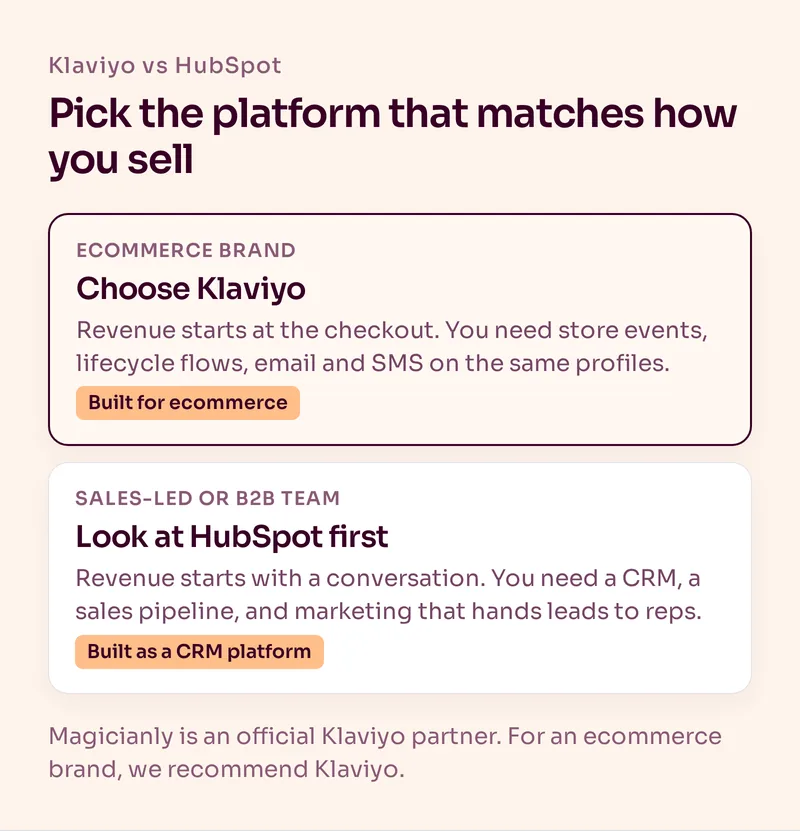
Quick answer: For an ecommerce brand, we recommend Klaviyo. It is built around store data, checkout behavior, email and SMS on the same profiles. HubSpot is a strong CRM and marketing platform when revenue starts with a sales conversation, a pipeline and a handoff to a rep. If you sell on Shopify or a similar store and the job is retention, pick Klaviyo.
Magicianly is an official Klaviyo partner. We'll say clearly where HubSpot is the better fit, and you should still check both pricing pages at your real list size before you sign anything.
The comparison people want is usually this: can HubSpot do what Klaviyo does for a store, and is it cheaper? Those are the wrong first questions. The useful one is how you sell.
By Emiel Dingemans, Founder of Magicianly
Updated
What Is Klaviyo Built For, and What Is HubSpot Built For?
Klaviyo started in ecommerce and still thinks like an ecommerce tool. Once the Shopify integration is in place, store activity lands on the customer profile as events: Viewed Product, Added to Cart, Checkout Started, Placed Order. Flows, segments and campaigns are built on that timeline. SMS sits in the same account, on the same profiles. That is the system we use when we run email and SMS for ecommerce brands.
HubSpot is a customer platform. Marketing Hub is the marketing piece, sitting next to Sales Hub, Service Hub and the rest of the CRM. The official Marketing Hub page positions it around demand generation: forms, email, ads, social, SEO, live chat, and marketing that feeds a sales team. HubSpot also has Revenue Hub, formerly Commerce Hub, which is built for quoting, contracts, billing and payments. That is a sales-led revenue process, not a Shopify storefront email program.
Both tools can send email. They are aimed at different businesses.
Klaviyo vs HubSpot at a Glance
| Klaviyo | HubSpot | |
|---|---|---|
| Built for | Ecommerce stores and retention | CRM, inbound marketing and sales teams |
| Customer data | Store events on the profile, in real time once the integration is running | CRM records, marketing contacts, sales activity |
| Email and SMS | Email and mobile messaging in one account, on the same profiles | Marketing email in Marketing Hub. The product page also lists SMS and WhatsApp as mobile messaging |
| Best fit | Brands whose revenue starts at the checkout | Teams whose revenue starts with a conversation |
| How they bill | Email plans scale with active profiles. Mobile messaging is a separate plan | Marketing Hub tiers, marketing contacts and user seats |
| Our pick for ecommerce | Yes | No, unless you also need the CRM and sales stack and you accept a weaker ecommerce lifecycle setup |
This table is a starting point, not a feature checklist. Feature lists go stale. The job each platform was designed to do does not.
Where Klaviyo Wins for Ecommerce
The difference shows up the first time you want to treat a shopper as a shopper, not as a lead.
On Klaviyo, a person who viewed the same product three times, added it to cart yesterday and has a predicted next-order date next week is already a usable segment. You do not have to invent a set of tags to keep that state in sync. Abandoned browse, cart, checkout, back in stock, replenishment and winback flows all start from events the store already sends.
We have run email and SMS for ecommerce brands that have generated more than $300M in client revenue, across 200+ brands. The work that moves repeat purchase rate almost always depends on store data being easy to use. Klaviyo gives you that without a pile of workarounds.
If you want the pricing mechanics in more depth, including what counts as an active profile, see our guide to Klaviyo pricing. For how we would build the reporting view inside the account, see how to build a Klaviyo dashboard.
Where HubSpot Wins
We would not tell a B2B company, a coach or a sales-led team to move to Klaviyo just because we like it for stores.
HubSpot is stronger when you need:
- A CRM that sales, marketing and service all work in.
- Lead capture, lead scoring and a clean handoff to a rep.
- Inbound marketing around a website: forms, landing pages, content, ads and social, in one place.
- A bi-directional Salesforce sync, which HubSpot documents on its Marketing Hub page, plus a large marketplace of other integrations.
- Quoting, contracts and billing in Revenue Hub, if that is how you take money.
If your pipeline is "book a demo, run a deal, close a contract," HubSpot is the more natural home. ActiveCampaign sits in a similar sales-and-marketing camp. We compared that one in Klaviyo vs ActiveCampaign. Mailchimp is a different comparison again, and we covered it in Klaviyo vs Mailchimp.
Can HubSpot Run an Ecommerce Store's Email?
Yes, in the sense that you can send campaigns, build automations and connect HubSpot to a store. HubSpot lists a Shopify integration, and Marketing Hub can send marketing email.
That is not the same as having the store as the center of the system. In our work, the flows that matter for a serious ecommerce program (browse, cart, checkout, post-purchase, replenishment, back in stock, sunset and winback) get easier when product views, carts and orders already live on the profile as events you can filter and split on. That is Klaviyo's default. It is not why people buy HubSpot.
If you already live in HubSpot for sales and you only need a simple newsletter plus a basic automation or two, you may be fine staying there. If the email program is supposed to drive repeat purchase rate, first-to-second purchase and contribution margin, we would put that work in Klaviyo.
Pricing: Compare the Units, Then Get a Real Quote
Do not pick a winner from the first number on a pricing page. The two products do not charge for the same thing.
On 22 November 2026, Klaviyo's pricing page listed a free plan for accounts with up to 250 active profiles, a paid Email plan starting at $20 per month for 500 active profiles and 5,000 emails per month, and a Marketing plan starting at $25 per month at that same email tier. Custom plans start above 150,000 active profiles. Mobile messaging is billed as a separate plan. Those figures change, so check the live page when you budget.
On the same day, HubSpot's Marketing Hub page listed a Free plan, a Starter plan (the page showed both $10 and $20 per month), Professional at $890 per month and Enterprise at $3,600 per month. Paid Marketing Hub plans also scale with marketing contacts and extra seats. Professional and Enterprise onboarding is a separate fee on HubSpot's side. Again, use the live page for the number that applies to you.
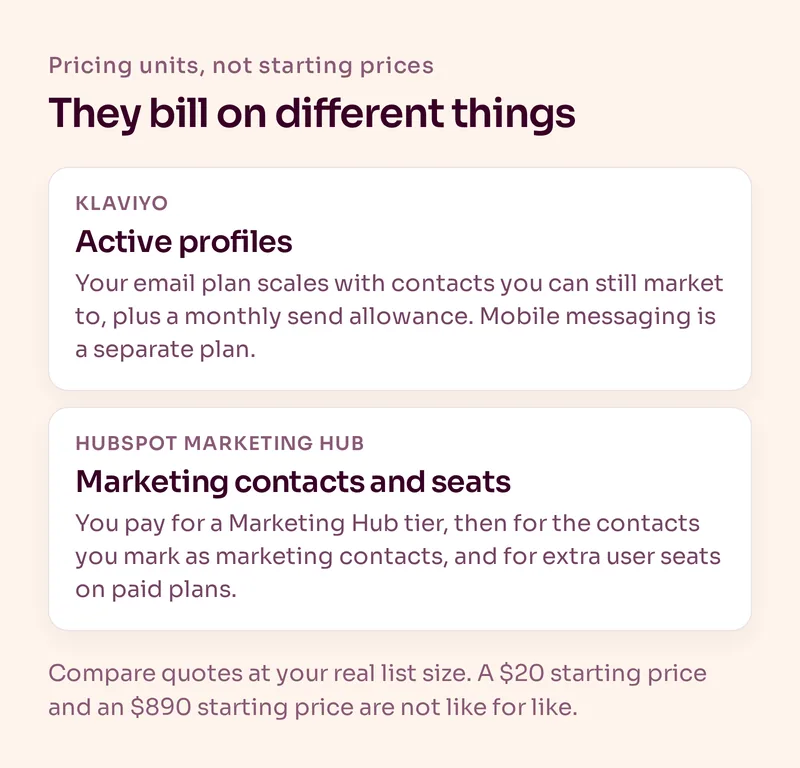
Get both quotes at your real list size. A starter price of $20 per month and a Professional price of $890 per month are not a like-for-like comparison.
Check what you are buying. Klaviyo's email price is mostly an active-profile tier plus sends. HubSpot's price is a Marketing Hub edition, plus marketing contacts, plus seats, plus any other Hubs you add.
Ignore attributed revenue as the ROI proof. A cheaper tool that you barely use, or a more expensive one that actually changes repeat purchase behavior, will not show up correctly if you only look at platform-attributed revenue.
For the ecommerce side of this, our Klaviyo pricing article walks through active profiles, suppressed contacts and why the bill tends to rise.
Should You Switch From HubSpot to Klaviyo?
If you run an ecommerce brand on HubSpot and the email program is starting to feel like a workaround, a move to Klaviyo is often the right call. Plan it as a rebuild, not a copy and paste. Your old automations were built around HubSpot's objects and tools. The better Klaviyo version of a flow usually looks different, because you can finally use store events directly.
If you are a sales-led company on Klaviyo and you are missing a real CRM, the answer may be the other way around, or a split: HubSpot for the sales team, Klaviyo for the store's lifecycle. We would only do that split when both jobs are real. Two platforms for one simple newsletter is a waste.
If you are still scanning alternatives more broadly, start with the best Klaviyo alternatives for ecommerce. That page is about ecommerce substitutes, which is why HubSpot only gets a short mention there.
Our Verdict
For ecommerce brands, we choose Klaviyo. It is the platform we would rather build and manage, and it is the one that matches how a store actually makes money.
HubSpot is a good platform pointed at a different target. If you sell through sales conversations, it may be the right call, and we would say so.
Frequently Asked Questions
Is Klaviyo better than HubSpot for ecommerce?
Yes, for an ecommerce brand we recommend Klaviyo. It is built around store events, lifecycle flows, and email and SMS on the same profiles. HubSpot is built as a CRM and marketing platform for teams that sell through conversations.
When should I choose HubSpot over Klaviyo?
Choose HubSpot when your revenue starts with a sales conversation and you need a CRM, a pipeline and marketing that hands leads to reps. That is a common fit for B2B, coaches and sales-led teams. It is not the fit we would pick for a Shopify retention program.
Can I use HubSpot and Klaviyo together?
Yes, some teams keep HubSpot as the CRM and sales tool and use Klaviyo for ecommerce email and SMS. That only pays off when both jobs are real. If you only need one of those jobs, pick the platform built for it and skip the extra stack.
Which is cheaper, Klaviyo or HubSpot?
It depends on your list size, the plan you actually need and which add-ons you turn on. On 22 November 2026, Klaviyo's paid Email plan started at $20 per month for 500 active profiles, and HubSpot Marketing Hub Professional was listed at $890 per month. Those are not comparable starting points. Get both quotes at your real contact volume.
Does HubSpot have SMS?
HubSpot's Marketing Hub page lists SMS and WhatsApp as mobile messaging. We would still check the current product and pricing pages for the plan you need, because mobile messaging is often packaged separately.
Does Klaviyo replace a CRM?
Not in the way HubSpot does. Klaviyo is strong as the customer data and messaging layer for an ecommerce brand. It is not a full sales CRM with deal pipelines, quoting and a service desk. If that is the job, HubSpot is the more natural tool.
Want Us to Build and Manage This for You?
Related Reading
Retention Strategy
Klaviyo Pricing Explained: What Ecommerce Brands Actually Pay in 2026Klaviyo pricing scales with active profiles, but the sticker price is only half the story. Here's what ecommerce brands actually pay, what drives the bill and when the premium is worth it.
Read NowRetention Strategy
Klaviyo vs ActiveCampaign: Which Is Better for Ecommerce in 2026?Klaviyo and ActiveCampaign can both send an abandoned cart email. The difference is what each one was built around. Here is how they compare for ecommerce, and when ActiveCampaign is the better fit.
Read NowRetention Strategy
Klaviyo vs Mailchimp: Which Is Better for Ecommerce in 2026?For sophisticated ecommerce brands, we would choose Klaviyo. Mailchimp can absolutely run ecommerce email, but Klaviyo gives retention teams a deeper customer-data and lifecycle platform.
Read NowAnalytics & Testing
How to Build a Klaviyo Dashboard That Helps an Ecommerce BrandA Klaviyo dashboard is a live snapshot, not a monthly scorecard. How to build one, when to use a custom report, and how we would organize the view.
Read Now