
Deliverability
Hard Bounce vs Soft Bounce: What They Mean and What to Do About Each
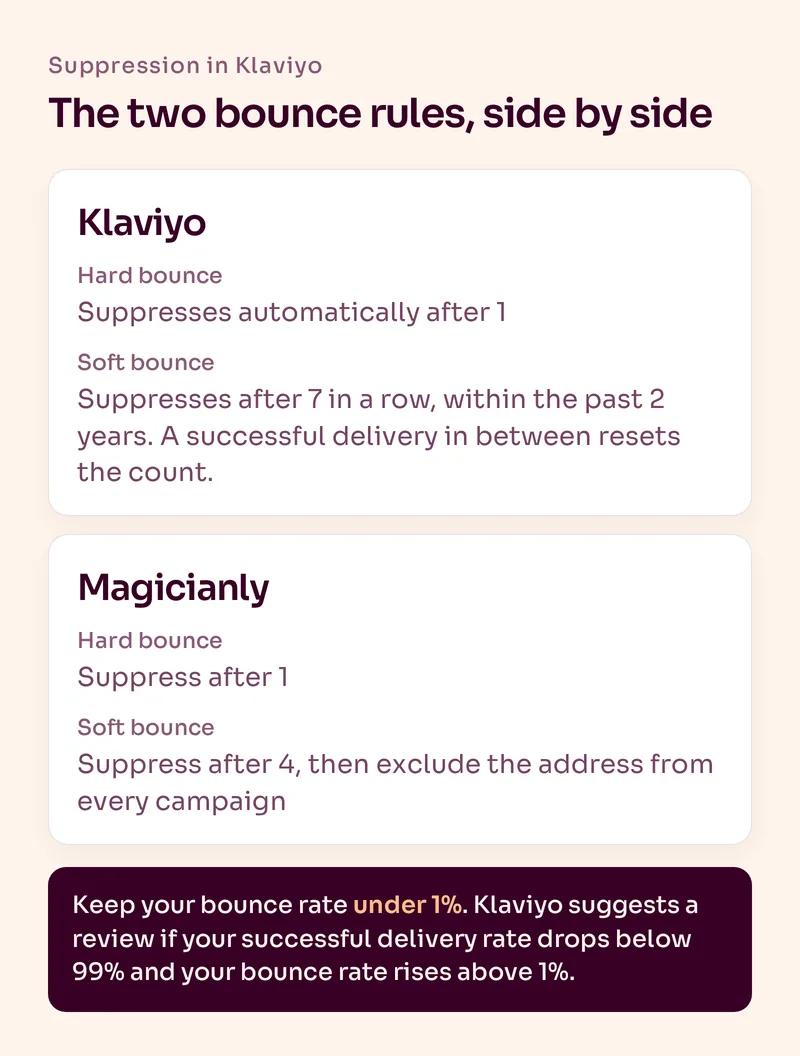
Quick answer: A hard bounce is a permanent delivery failure, like an address that doesn't exist. A soft bounce is a temporary one, like a full inbox or a server that's down. Klaviyo suppresses hard bounces automatically and soft bounces only after 7 in a row. We're stricter: we suppress after 1 hard bounce or 4 soft bounces, and exclude both from every campaign. Keep your bounce rate under 1%.
Inbox providers notice every bounce.
To them, it means you're mailing addresses that don't work.
Do that often enough and your good emails start landing in spam too.
By Emiel Dingemans, Founder of Magicianly
Updated
What Is a Hard Bounce?
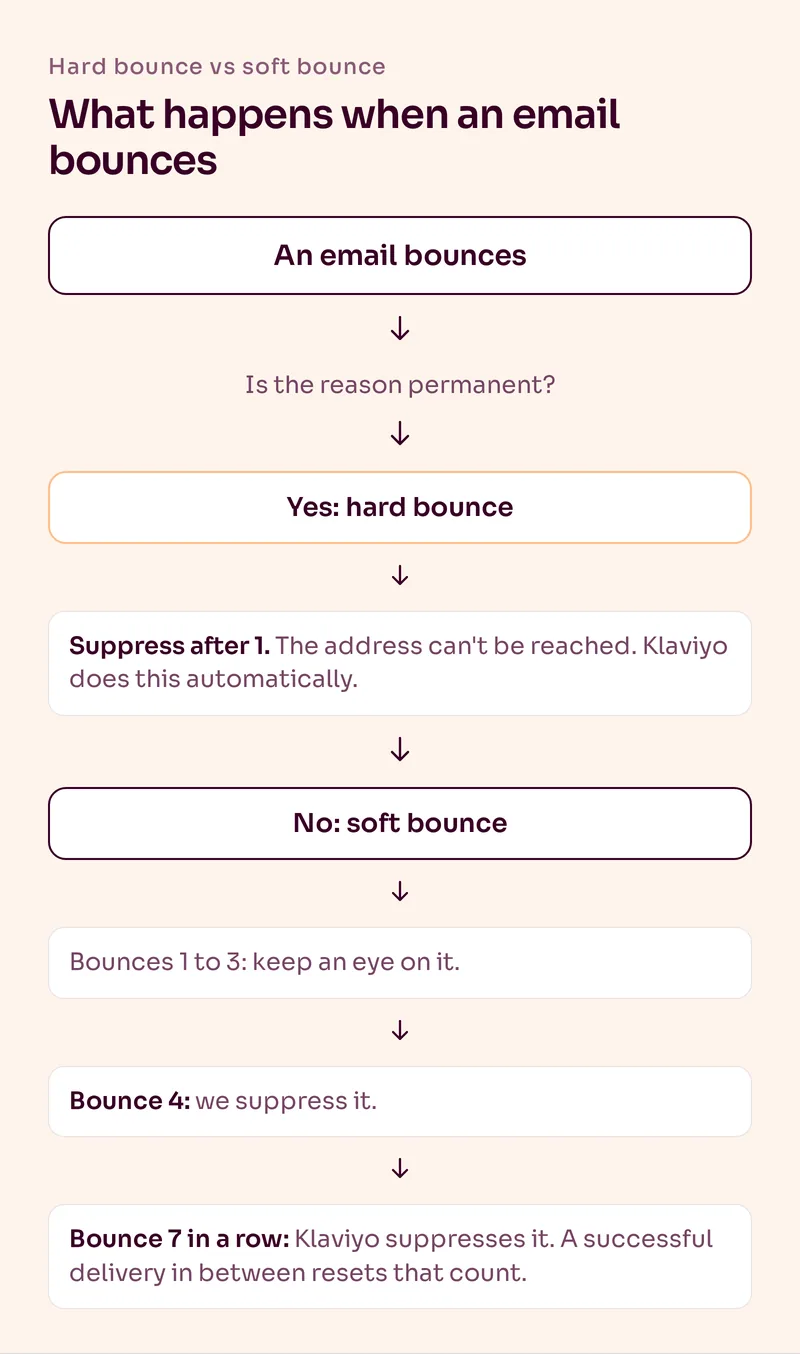
A hard bounce happens when an email can't be delivered for a permanent reason. The most common one is an address that doesn't exist, often because of a typo or a fake signup.
Klaviyo suppresses any address that hard bounces, automatically. Your only job is to check it's actually happening after an import or a migration. There's nothing to gain from mailing that address again.
What Is a Soft Bounce?
A soft bounce happens when an email can't be delivered for a temporary reason, like a full inbox or a recipient's mail server being briefly down.
The key word is temporary. The address might work next week. But if the same address keeps soft bouncing, the problem isn't temporary anymore. Klaviyo suppresses an address after 7 consecutive soft bounces within the past 2 years. A successful delivery in between resets the count.
What Is the Difference Between a Hard Bounce and a Soft Bounce?
Hard bounces are permanent and soft bounces are temporary. That decides what you do next.
| Hard bounce | Soft bounce | |
|---|---|---|
| Cause | A permanent reason, like an address that doesn't exist or a deliberate block by the email server | A temporary reason, like a full inbox or a server that's down |
| Will it work later? | No | Maybe |
| What Klaviyo does automatically | Suppresses the address after one hard bounce | Suppresses the address after 7 consecutive soft bounces within 2 years |
| What we do | Suppress after 1 | Suppress after 4 |
| Risk if you keep sending | You send to a dead address every time | You keep sending to an address that probably won't fix itself |
Why Do Emails Bounce?
Mostly bad addresses, full inboxes, reputation problems and technical setup mistakes. Klaviyo sorts bounces into 11 categories, and the reason tells you what to fix.
| Bounce reason | What it means | What to do |
|---|---|---|
| Invalid address | The address doesn't exist, often a typo or a fake signup | Keep it suppressed. Fix the signup source if you see many |
| Mailbox unavailable | The mailbox is full, has a temporary auto-reply or the recipient's server has an error | Wait it out. Suppress if it repeats |
| Reputation | The mailbox provider thinks your sender reputation is poor | Send to engaged segments only and check Google Postmaster Tools |
| Technical | Missing DNS records or authentication problems | Check your branded sending domain and DNS records |
| Frequency or volume too high | The provider can't or won't process that many messages | Send fewer messages at once and ramp up slowly |
| Content | The email looks like messages the provider has classed as spam | Review the content and your recent complaint rate |
Klaviyo also lists message size, message length, invalid sender address and unclassified reasons. The quickest ones to fix are usually the technical and reputation bounces.
What Is Our Rule for Suppressing Bounces?
Suppress after 1 hard bounce or 4 soft bounces, and exclude both from every campaign. Four tries is enough to know something's wrong.
That's stricter than Klaviyo's automatic rule of 7 consecutive soft bounces. Klaviyo points the same way: its Help Center suggests a cleanup segment of profiles with at least 4 bounced emails in the last 90 days, and notes that those don't have to be consecutive. Every bounce costs you a little deliverability, so we don't see a reason to wait for 7.
To build it in Klaviyo:
- Create a segment for people who bounced an email at least 1 time where the bounce type is hard, and who can receive email marketing.
- Create a second segment for people who bounced an email at least 4 times where the bounce type is soft, and who can receive email marketing.
- Exclude both segments from your campaigns.
- Suppress the current members of each segment, so they can no longer receive marketing email.
Exclusions and suppression work together. Our Klaviyo segmentation strategy shows how we set up the default exclusions, and our guide to cleaning your email list in Klaviyo covers the rest of the process.
What Is a Good Bounce Rate?
Under 1%. Bounce rate is the number of bounced emails divided by the number of emails sent.
Klaviyo's guidance is to review your sending practices and clean your list if your successful delivery rate drops below 99% and your bounce rate rises above 1%. We'd treat any sudden jump as a signal, even if you're still under that line.
Google's sender guidelines point the same way. They recommend automatically unsubscribing recipients with multiple bounced messages, and reducing your volume if bounces or deferrals start piling up.
Why Did My Bounce Rate Suddenly Go Up?
Something changed, either in where your addresses come from or in how you send. Check these four things first.
- Bots on your signup forms. A jump in new subscribers that doesn't match your traffic, plus welcome emails bouncing, usually means bots. We switch on double opt-in temporarily in this case, then switch it back.
- A list import or migration. Old and imported lists often contain dead addresses. Check the bounce rate on the first send after any import.
- A DNS or authentication change. Technical bounces appear when records go missing or break. Our branded sending domain guide covers the setup.
- Sending to a cold list. If you email people who haven't engaged in a long time, you meet more dead addresses and more reputation problems. See our email list cleaning guide.
Where Do You See Bounces in Klaviyo?
In the deliverability hub. In Klaviyo, go to Analytics, then Deliverability, select Email and open Bounce details.
You'll see a heatmap of bounce categories against your biggest inbox providers, plus a table with each bounce's type, provider, category and definition. To see the profiles themselves, open your suppressed profiles and filter by the suppression reason "Email bounced".
When we audit an account we start with the deliverability tab of the last five campaigns, and look at bounce rate by inbox provider. Gmail can be fine while Hotmail and Outlook are not. Pair that with Google Postmaster Tools for Gmail's own view.
Can You Save a Bounced Email Address?
Sometimes, if it's a typo. If a hard bounce looks like a mistake, correct the address and send a one-off email to it.
That's Klaviyo's own advice for invalid addresses. If it still bounces, leave it suppressed. Don't try to win these back.
The Short Version
A hard bounce is permanent. A soft bounce is temporary, until it repeats. Klaviyo suppresses hard bounces at once and soft bounces after 7 in a row. We suppress after 1 hard bounce or 4 soft bounces, exclude both from every campaign and keep the bounce rate under 1%.
If your bounce rate jumps, check bots, imports and DNS before you blame the email.
Our email deliverability checklist puts bounces in the wider picture. For the cleanup itself, start with our Klaviyo list-cleaning process. If you'd like this handled for you, see our email marketing services.
Frequently Asked Questions
What is the difference between a hard bounce and a soft bounce?
A hard bounce is a permanent delivery failure, like an address that doesn't exist. A soft bounce is a temporary failure, like a full inbox or a server that's down.
How many soft bounces before an address is suppressed in Klaviyo?
Klaviyo automatically suppresses an address after 7 consecutive soft bounces within the past 2 years. A successful delivery in between resets the count. We suppress earlier, after 4 soft bounces.
Does Klaviyo suppress hard bounces automatically?
Yes. Klaviyo automatically suppresses any email address that hard bounces and removes it from any lists it was on.
What is a good email bounce rate?
Under 1%. Klaviyo suggests reviewing your sending practices and cleaning your list if your successful delivery rate drops below 99% and your bounce rate rises above 1%.
Can a soft bounce turn into a hard bounce?
A soft bounce is temporary by definition, but an address that keeps soft bouncing is effectively dead. Klaviyo suppresses it after 7 consecutive soft bounces, and we suppress it after 4.
Why are my emails bouncing?
The most common reasons are invalid addresses, full mailboxes, a poor sender reputation and technical problems like missing DNS records. Klaviyo's Bounce details page shows the reason for each bounce.
Want Us to Build and Manage This for You?
Related Reading
Deliverability
Email Deliverability Checklist for Ecommerce Brands in 2026Deliverability is mostly the result of who you send to, how often and whether they want it. Here is the checklist we work through for ecommerce email programs.
Read NowDeliverability
How to Clean Your Email List in KlaviyoA practical Klaviyo list-cleaning process that separates valuable lapsed customers from subscribers who should genuinely be suppressed.
Read NowDeliverability
Email List Cleaning: When to Suppress Inactive SubscribersA bigger email list is not automatically a better email list. Here is how we separate inactive subscribers from valuable past customers and when suppression actually makes sense.
Read NowList Growth
Single vs Double Opt-In: Which Should Your Ecommerce Brand Use?Double opt-in keeps your list clean but costs you real subscribers. When we use single vs double opt-in for email and SMS, and how to change it in Klaviyo.
Read Now