
Deliverability
BIMI for Email: What It Is, What It Costs and Whether Your Brand Needs It
Quick answer: BIMI (Brand Indicators for Message Identification) puts your logo next to your emails in inboxes that support it, like Gmail and Yahoo. You need DMARC at enforcement (quarantine or reject), a square SVG logo and, for Gmail, a mark certificate (VMC or CMC). Think of it as a brand layer on top of your email authentication. It won't fix deliverability on its own. We see it as an optional extra for bigger brands that already have the basics sorted. The certificate is the main cost, at roughly $1,500 a year.
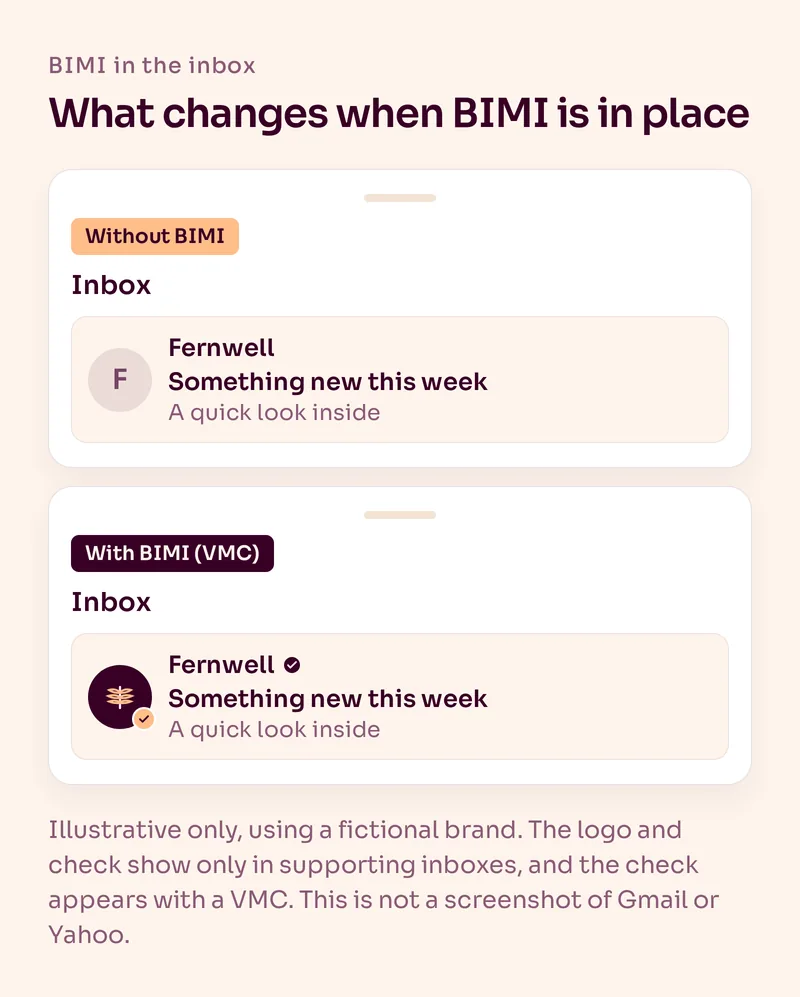
Scroll through a Gmail inbox and most senders look the same.
Just a name, a subject line and a gray circle with one letter in it.
BIMI replaces that circle with your logo. Whether that's worth a few thousand dollars comes down to where your brand is today.
By Emiel Dingemans, Founder of Magicianly
Updated
What Is BIMI?
BIMI is an email standard that lets you choose the logo that shows up next to your emails in inboxes that support it. It runs through your DNS settings, and the logo only appears on email that passes authentication.
It stands for Brand Indicators for Message Identification, and you say it "bih-mee". In Gmail, senders with a Verified Mark Certificate also get a blue check next to their name.
It builds on the work you've (hopefully) already done for email authentication: SPF, DKIM and DMARC. No enforced DMARC, no BIMI.
What Do You Need for BIMI?
Five things: authentication that passes, DMARC at enforcement, a logo in the right format, a mark certificate and a DNS record.
SPF, DKIM and DMARC alignment
p=quarantine or p=reject, pct=100
SVG Tiny PS, hosted over HTTPS
VMC or CMC from a certificate authority
TXT at default._bimi on your domain
- SPF, DKIM and DMARC that pass. That means every tool that sends email from your domain: Klaviyo, but also your helpdesk, Shopify and invoicing tools. Check them all before you enforce anything.
- DMARC at p=quarantine or p=reject, applied to 100% of messages (pct=100). This applies to your root domain and your sending subdomains, and p=none doesn't count. Heads up: Klaviyo's "Add DMARC record" option suggests p=none, so you'll have to change it. The details are in Klaviyo's BIMI guide.
- A branded sending domain on the same root domain as your From address. Here's how to set up a branded sending domain in Klaviyo.
- A logo in SVG Tiny PS format. Square, centered, no extra text, hosted over HTTPS. Klaviyo recommends 32 KB or smaller. Google's BIMI guide adds that Gmail needs at least 96 by 96 pixels in absolute units, and recommends a solid background.
- A mark certificate. For Gmail you need a VMC or a CMC from a certificate authority. Klaviyo doesn't issue them.
Last step: a BIMI record in your DNS that points to the logo and the certificate.
What Is the Difference Between a VMC and a CMC?
A VMC needs a trademarked logo and gets you Gmail's blue check. A CMC doesn't need a trademark, and you don't get the check.
| Verified Mark Certificate (VMC) | Common Mark Certificate (CMC) | |
|---|---|---|
| Logo requirement | A trademarked logo, registered with an office the issuer recognizes | No trademark needed |
| Logo shown in Gmail | Yes | Yes |
| Blue check in Gmail | Yes | No |
| Good fit when | You hold the trademark and want the full effect | You don't have a trademark, or it's still pending |
Google says getting a trademark can take 6 to 12 months. If yours isn't registered yet, a CMC gets your logo into Gmail a lot sooner.
Which Inboxes Support BIMI?
Gmail and Yahoo support BIMI, and so do certain versions of Apple Mail. Outlook works differently.
Gmail shows the blue check for VMC senders on the web and in its Android and iOS apps. Google says the check isn't shown in Apple Mail or other mail apps. For Outlook, Klaviyo points to Bing Pages as the way to add a brand logo.
Even in Gmail or Yahoo there's no guarantee. Each provider decides based on its own authentication, certificate and sender reputation checks. In inboxes that don't support BIMI, nothing changes.
Does BIMI Improve Deliverability?
Not by itself. BIMI sits on top of authentication. It doesn't change how Gmail decides between Primary, Promotions and spam.
This is the part people get wrong. A logo can make your email easier to spot in a busy inbox. If your list is stale and your complaint rate is high, though, a logo won't save you. We'd fix those first, with our email deliverability checklist.
BIMI also isn't one of Google's sender requirements for Gmail. Those cover authentication, DMARC for bulk senders, unsubscribe handling and spam rate. BIMI is optional.
How Much Does BIMI Cost?
The certificate is most of it. We use roughly $1,500 a year as a ballpark, so check the current price with the issuer before you buy.
Prices vary by issuer, certificate type and term, and you'll have to renew it. Add a bit of design time for the SVG, some DNS work and, for a VMC, the cost of registering your trademark if you don't have one yet.
Klaviyo doesn't sell certificates, so you buy one from a certificate authority. The BIMI Group keeps a list of issuers, and its implementation guide covers the record format.
Is BIMI Worth It for Ecommerce Brands?
For most brands it's a nice-to-have. We recommend it for eight and nine figure brands, and sometimes for seven figure brands, once the basics are done.
Worth it when: your DMARC is already enforced, your list is clean, your complaint rate is low, you have a trademarked logo or can use a CMC, and a roughly $1,500 yearly cost is small next to your email revenue.
Skip it for now when: you haven't set up DMARC yet, you still send to a stale list, your placement or spam rate is a problem, or the same budget would buy more testing, segmentation or flows.
Order matters here. Authentication first, then list quality and engagement, and only then BIMI. We cover the first two in our guide to Klaviyo email deliverability, and the list part in how to clean your email list in Klaviyo.
If email is a real revenue channel for you, our email marketing services include the technical setup.
How Do You Set Up BIMI in Klaviyo?
Get DMARC to enforcement first, then add the logo, the certificate and a DNS record. Here's the order we'd follow.
- Activate a branded sending domain on the same root domain as your From address.
- Find every service that sends email as your domain, and fix any that fail DMARC. Klaviyo warns that messages that fail can be sent to spam or rejected once you enforce.
- Move your DMARC policy to p=quarantine or p=reject with pct=100.
- Prepare your SVG Tiny PS logo.
- Buy a VMC or CMC from a certificate authority.
- Host the logo and certificate files over HTTPS.
- Publish the BIMI TXT record, then send a test to Gmail and Yahoo.
The BIMI record sits at default._bimi on your domain and looks like this, with your own URLs:
Host: default._bimi.yourdomain.com
Type: TXT
Value: v=BIMI1; l=https://yourdomain.com/logo.svg; a=https://yourdomain.com/certificate.pem
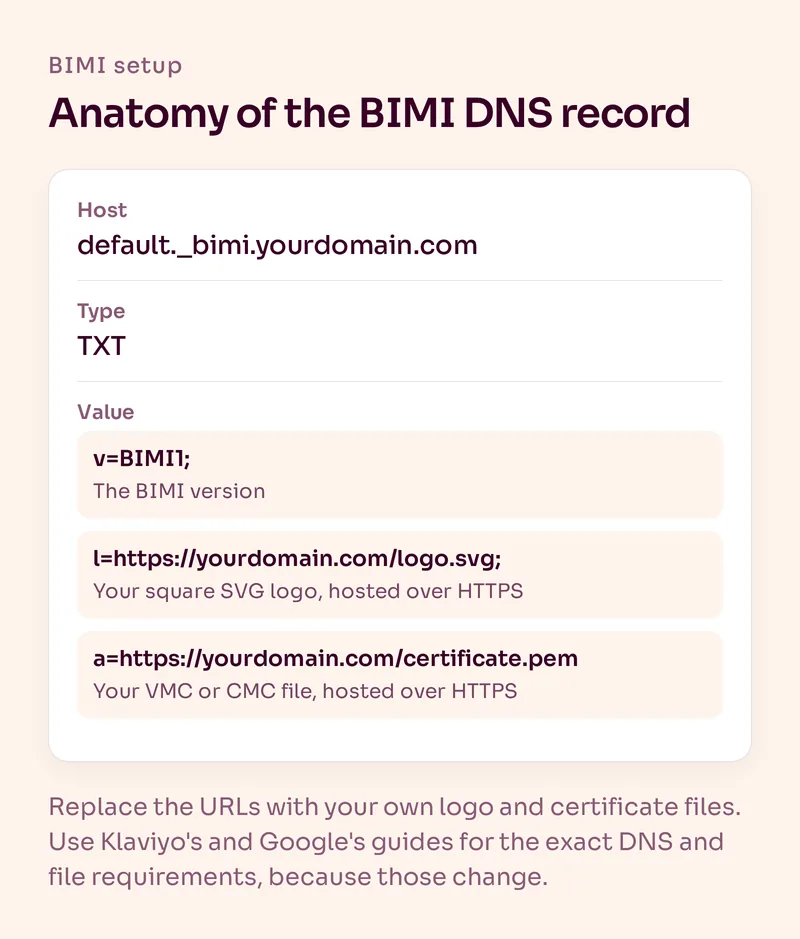
For the exact DNS and file specs, follow Klaviyo's and Google's guides. Those requirements do change.
What Can Go Wrong With BIMI?
Usually DMARC or the logo file. The BIMI record itself is the easy part.
- DMARC still at p=none. BIMI won't work until it's at quarantine or reject with pct=100.
- A sender you forgot. Once DMARC is enforced, email from a tool that fails authentication can go to spam or get rejected.
- The wrong logo file. It has to be SVG Tiny PS, square and centered, and Gmail wants absolute pixel sizes. Percentages won't work.
- No certificate. For Gmail, a BIMI record without a VMC or CMC won't show your logo.
- Weak reputation. Providers can still decline to show the logo if your sender reputation is poor.
The Short Version
BIMI gets your logo into Gmail, Yahoo and some versions of Apple Mail. You need DMARC at enforcement, an SVG logo and a VMC or CMC. On its own it doesn't improve deliverability. We treat it as an optional extra for larger brands, once authentication and list quality are in good shape.
Get the foundations right first. Then decide if the logo is worth roughly $1,500 a year to you.
Frequently Asked Questions
What does BIMI stand for?
Brand Indicators for Message Identification. It's an email standard that lets brands show a verified logo next to their emails in inboxes that support it.
Do I need a VMC for BIMI?
For Gmail you need either a Verified Mark Certificate (VMC) or a Common Mark Certificate (CMC). A VMC requires a trademarked logo and gets you Gmail's blue check. A CMC doesn't require a trademark and doesn't get the check.
Does BIMI work in Outlook?
Not in the same way. Klaviyo points to Bing Pages for adding a brand logo in Outlook inboxes. BIMI itself is supported by Gmail, Yahoo and certain versions of Apple Mail.
Does BIMI improve open rates or inbox placement?
Not by itself. BIMI doesn't change how Gmail filters your email. A logo may make your brand easier to recognize, but treat any open rate lift as unproven until you test it.
Does Klaviyo support BIMI?
Yes. You need a branded sending domain on the same root domain as your From address, SPF, DKIM and DMARC that pass, and DMARC at quarantine or reject with pct=100. Klaviyo doesn't issue VMCs or CMCs, so you buy those from a certificate authority.
Is BIMI required by Gmail's sender rules?
No. Google's sender requirements cover authentication, DMARC for bulk senders, unsubscribe handling and spam rate. BIMI is optional.
Want Us to Build and Manage This for You?
Related Reading
Deliverability
How to Fix Email Deliverability Problems in KlaviyoA practical ecommerce deliverability framework covering technical setup, list hygiene, engagement and controlled audience expansion.
Read NowDeliverability
How to Set Up a Branded Sending Domain in KlaviyoA practical guide to setting up a branded sending domain in Klaviyo and understanding where it fits into your wider email authentication setup.
Read NowDeliverability
Email Deliverability Checklist for Ecommerce Brands in 2026Deliverability is mostly the result of who you send to, how often and whether they want it. Here is the checklist we work through for ecommerce email programs.
Read NowDeliverability
How to Clean Your Email List in KlaviyoA practical Klaviyo list-cleaning process that separates valuable lapsed customers from subscribers who should genuinely be suppressed.
Read Now